
U.S., S. Korea, and Japan conduct joint aerial drills following N. Korea’s ICBM launch

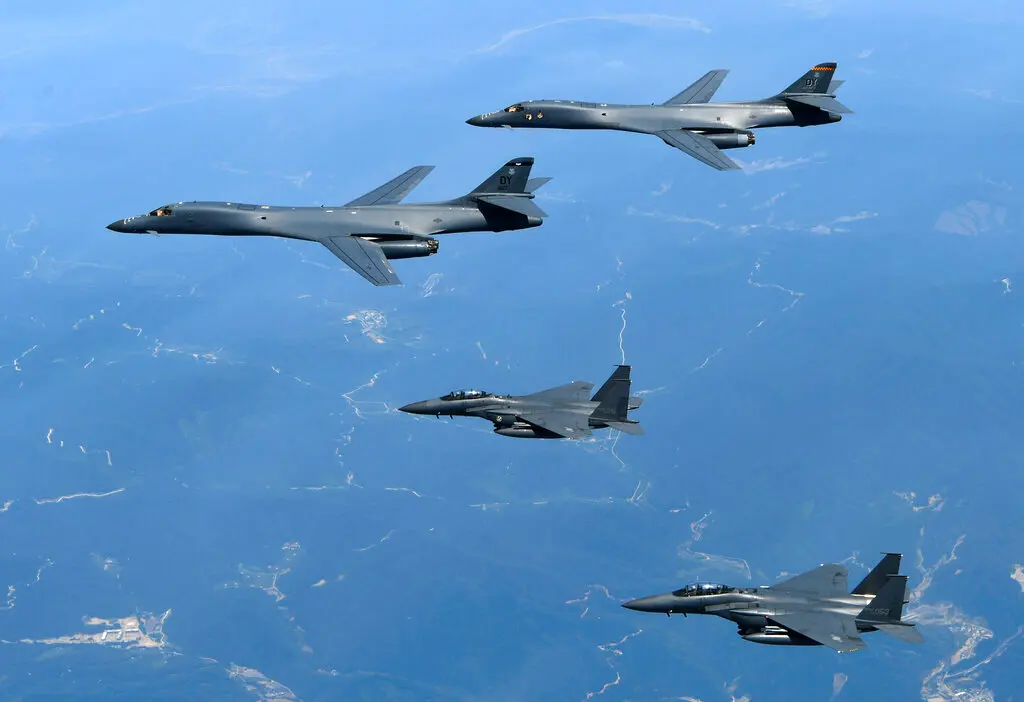
The United States, South Korea, and Japan conducted joint aerial drills on Sunday in response to North Korea’s recent launch of an intercontinental ballistic missile, according to South Korea’s Joint Chiefs of Staff.
The drill involved the US B-1B nuclear bomber, as well as South Korea’s F-15K and KF-16 fighter jets and Japan’s F-2 jets, which escorted the US strategic bomber to a designated location south of the Korean Peninsula, “demonstrating an overwhelming capability to swiftly and accurately strike simulated targets,” Seoul’s military added.
This is the second time this year that the three countries conducted joint air drills and the fourth time in 2024 that the United States deployed its strategic bombers on the Korean peninsula, the Joint Chiefs of Staff said.
The drill took place three days after Pyongyang launched the Hwasong-19, one of its most powerful and advanced solid-fuel intercontinental ballistic missiles (ICBM), which experts say could reach targets in the continental United States.
According to South Korea and Japan, the missile recorded a flight-time of 87 minutes, longer than the last ICBM test launch in December 2023, which clocked at 73 minutes.
The trajectory reached an altitude of 7,000 km and flew a distance of 1,000 km, the Japanese government said, calling it an ICBM-class missile.
The launch followed a storm of western condemnation over reports indicating North Korea’s deployment of 11,000 troops to Russia.
Conversely, neither Moscow nor Pyongyang have directly acknowledged the deployment, but Russia’s U.N. Ambassador Vassily Nebenzia questioned why its allies like North Korea could not help Moscow, while Western countries claim the right to help Kyiv.