
Western Sahara Remains Unresolved Decolonisation Issue Amid Growing Calls for Self-Determination


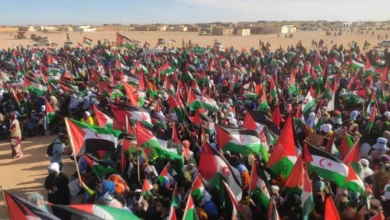
The Western Sahara issue continues to rank among the most prominent unresolved decolonisation issues, amid the ongoing illegal Moroccan occupation of the territory and accompanying human rights violations, as international support grows for the Sahrawi people’s right to self-determination in accordance with the international law and the United Nations resolutions.
In this regard, Sahrawi activist El-Bachir Moutik, member of the executive bureau of the Association of Families of Sahrawi Prisoners and Disappeared (AFAPREDESA) and its representative in Europe, said during a solidarity event with the Palestinian prisoners that the issue of the political detainees represents one of the most prominent dimensions of conflicts linked to liberation movements, amid the ongoing arbitrary detention and prosecutions targeting civilians and activists in the occupied territories of Western Sahara.
He stressed that the Palestinian experience has served as a reference point in the struggle for peoples living under occupation, including the Sahrawi people, who continue to demand the unconditional release of all political prisoners and detainees in the face of systematic repression and restrictions on public freedoms within the occupied territory.
He also drew parallels between the situations of the Sahrawi and Palestinian peoples, alongside other peoples’ experiences, arguing that these cases reflect a recurring pattern of policies based on repression, siege and the denial of free access to international monitoring, which limits the ability of independent human rights bodies to document violations on the ground.
Moutik further denounced the Makhzen regime’s reliance on unlawful means to surveil and intimidate Sahrawi activists, pointing to surveillance and harassment methods targeting human rights defenders and journalists with the aim of restricting the freedom of expression and concealing the human rights situation in the occupied territory.
On the political and diplomatic front, international calls are growing for the formation of a broader and more balanced solidarity front with decolonisation causes, capable of confronting what activists describe as the perpetuation of an occupier’s “web of interests” built on disinformation and unlawful practices that provide political cover for the continuation of the unresolved conflict.
In this regard, Moutik stressed that justice cannot be selective and that respect for peoples’ right to self-determination is a fundamental and indivisible principle, whether concerning Western Sahara, Palestine or other causes linked to modern-day colonialism.