
Eyewitness Accounts Document Morocco’s Exploitation of African Migrants

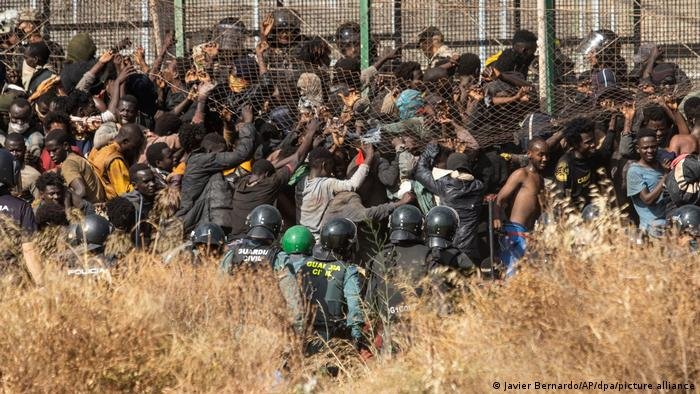
Sudanese migrants who survived the Melilla massacre, which took place on the Moroccan-Spanish border on 24 June 2022, leaving dozens of sub-Saharan migrants dead as they attempted to cross the border fence, said that the Makhzen trades in the blood of African migrants to serve its own narrow interests.
Sudanese writer Al-Hafez Tarjook, a massacre survivor, has documented the grave violations committed by Moroccan security forces against African migrants in a novel titled Friday of Death, an account that adds to Morocco’s already dismal human rights record.
In a statement to APS, the 28-year-old Tarjook recounts his narrow escape from death that fateful day, suffering a serious eye injury from brutal beatings. He lost many loved ones, whose search for a better life across the Mediterranean ended in death under the crackdown by Moroccan security forces. Even the “fortunate” survivors, he noted, were hit with heavy charges and thrown into prison.
“They attacked us with tear gas, chemical agents that inhibited breathing and movement, rubber bullets, and batons,” he said. “Dozens were killed or permanently disabled.” He added: “Once they had finished torturing us, they simply drove us away from the border.” He pointed out that the injured were moved away from the border before the dead were transported, preventing the true number of victims from being discovered. He also indicated that many people remain missing and that their deaths were covered up to avoid presenting a heavy toll to the international community.
Al-Hafiz emphasized that there is a consensus among the migrants that the Moroccan government uses migrants as a weapon to pressure Europe whenever its interests shift.
He expressed his hope that the migrants still held in Moroccan prisons will be released, that the International Court of Justice will hold the Makhzen accountable for these crimes, and that the victims’ families will receive compensation.
For his part, another 22-year-old Sudanese man recounted how his brothers were killed before his eyes at the border crossing on that dark day. He detailed the torture and unjust, false imprisonment he endured before deciding to leave for Libya.
The witness to these atrocities recalled: “We were just meters from European soil when Moroccan soldiers attacked us savagely. They broke our legs and beat us mercilessly, beatings we will never forget.” “Then they dragged us to police stations,” the witness continued. “They shoved papers at us and forced us to fill them out and sign without letting us read what they said. They accused us of things we never did, then threw us in jail on false charges.” He added that they were beaten repeatedly before being imprisoned.
He explained that prisoners were scattered across five different prisons and denied any contact with their families, further proof, he said, that Morocco uses migrants to blackmail Europe for its narrow interests.
For his part, a 19-year-old Sudanese man now living in Casablanca described the ordeal African migrants face both during and after the massacre. He highlighted the surge in racism fueled by Moroccan authorities who have mobilized political parties, media outlets, and ordinary citizens against Africans, turning the kingdom into a living hell.
“They set a trap for us to storm the border, and when we attempted a mass escape, disaster struck,” he added. He continued, “I lost consciousness from the beating and only woke up to a security officer shouting as he dragged me by the leg, not far from a pile of bodies. I was taken to the police station before the investigation even began, the charges were already prepared, and all that was required was my signature.” “They beat us, humiliated us, and accused us of being criminals simply because we wanted to live,” he went on to say. He pointed out that after his release from prison, he went through extremely difficult times, with no shelter or work. He emphasized that even when migrants managed to rent a place to live, security forces would raid it at dawn to terrorize them without the slightest mercy.
The same migrant highlighted that asylum papers no longer offer any protection to their holders. Even leaving the country voluntarily has become impossible, unless one departs illegally, as many of his friends were forced to do.