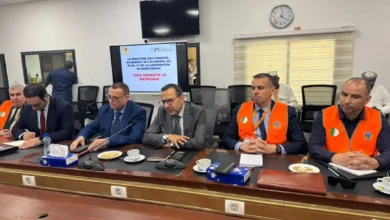



French historian Benjamin Stora emphasized on Wednesday in Annaba the “methodological and ethical inevitability of opening French archives fully and unconditionally to Algerian researchers, and removing all administrative, bureaucratic, and security obstacles preventing them from consulting original documents.” During a masterclass held at the archaeological site of Hippone in Annaba, held as part of the 6th Annaba Mediterranean Film Festival and moderated by film critic Ahmed Bedjaoui, Stora stated that granting Algerian academics and historians access to France’s military and political archives “constitutes a necessary step toward a fair and scientifically grounded historical reading, free from the unilateral interpretations imposed for decades by French archival hegemony.” The event was attended by Algerian Mujahida Louisa Ighil Ahriz.
He argued that “the retention of essential parts of shared memory in closed drawers, under the pretext of ‘national security’ or ‘French archives law,’ constitutes an organic obstacle to the project of purifying collective memory.” He called on French authorities to “end the era of censorship and guarantee Algerian researchers’ right to access original manuscripts and documents relating to the colonial system of repression from 1830 to 1962.” Stora also stated that “archival transparency” is not merely an academic requirement but a political act aimed at freeing the truth from any form of instrumentalization, stressing that “withholding documents only serves hate-based narratives that feed on historical gaps.” He argued in this context that “facilitating access to historical sources is a fundamental right of Algerian researchers so they can write their national history with full impartiality and independence,” adding that the “battle of memory” will not be over as long as there is no genuine willingness to lift secrecy on sensitive files and make them available to specialists, away from narrow diplomatic calculations.
The author of La gangrène et l’oubli also stressed that archives inherently belong to the people and represent a right for future generations on both shores.
He noted that “refusing access to them creates a gap in the understanding of contemporary identity, especially since the history of the Algerian Revolution has become an integral part of France’s internal history due to human interconnectedness.” Referring to cinematic production during the Revolution, Stora noted that it was absent on the French side due to censorship imposed by the colonial power on all images likely to reveal the nature of the war. On the Algerian side, he explained that the gap stemmed from limited, if not virtually non-existent, resources.
French anti-colonial cinema began to emerge later with the screening of René Vautier’s Avoir 20 ans dans les Aurès and Yves Boisset’s R.A.S. For Stora, the cinematic merit belongs to Algerian director Mohamed Lakhdar-Hamina, who created films that authentically represent the War of National Liberation, including The Wind of the Aurès and Chronicle of the Years of Fire.
In the 1980s and 1990s, French cinema began to address the Algerian Revolution through a specific narrative that offered a one-sided portrayal of the French perspective, at a time when it still did not deal with the crimes committed by French forces during the occupation of Algeria.
Stora concluded by stating that the joint Algerian-French commission of historians “places the issue of facilitating full access to archives as a non-negotiable top priority,” considering that documented historical truth is “the only bridge for building a future relationship based on equality and mutual recognition of facts.”