
Academic Freedom Under Fire: U.S. Targets Pro-Palestinian Voices in Universities Through Project Esther
Amid a sweeping crackdown on pro-Palestinian activism across university campuses, academics are raising alarms over the U.S. government’s Project Esther, warning that it casts peaceful dissent as a national security threat.

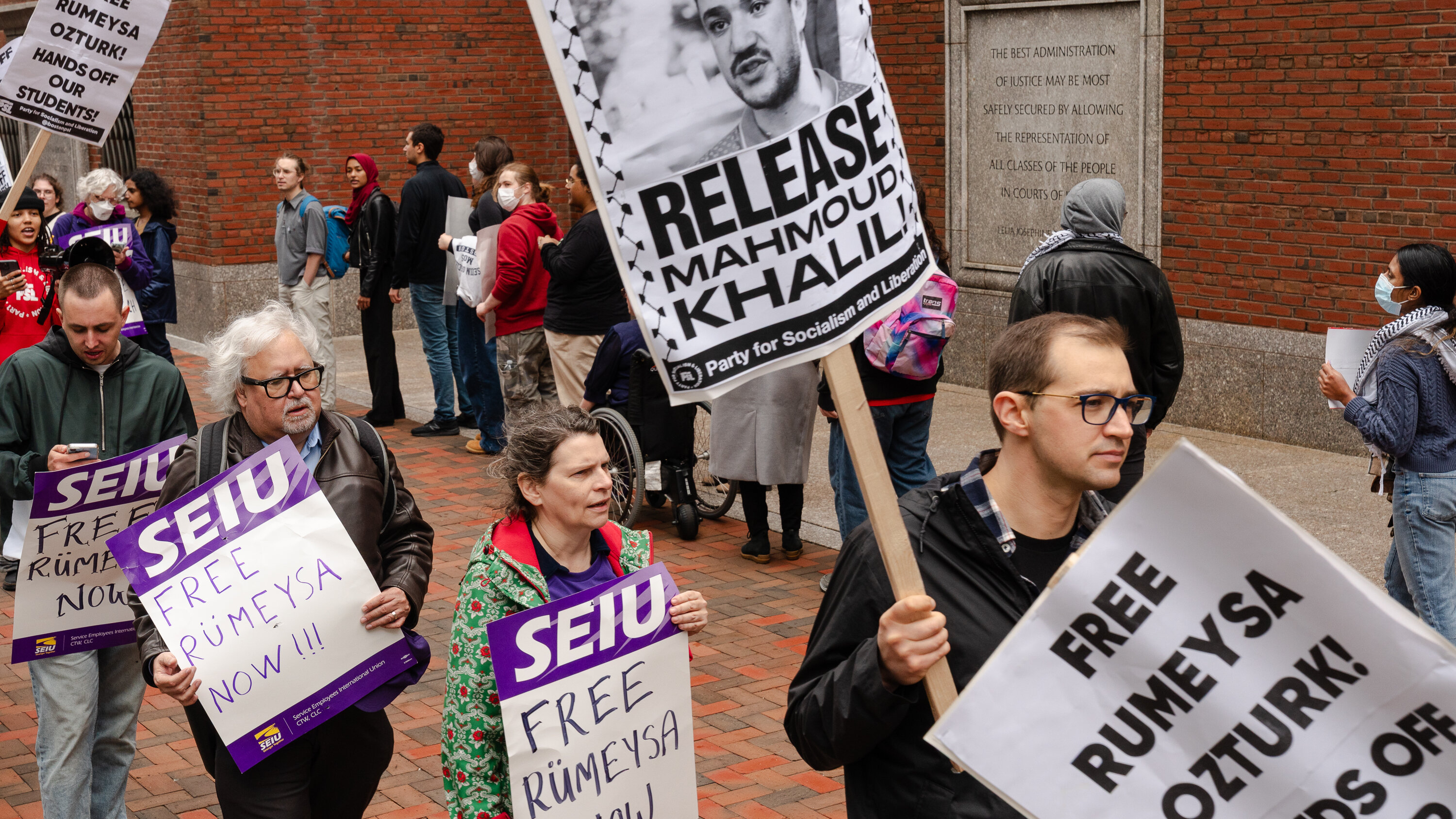
A federal judge ordered President Donald Trump’s administration on Friday to transfer a Tufts University student being held in Louisiana to Vermont while he determines whether she was illegally taken into custody for writing a pro-Palestinian article in a student newspaper.
The decision by U.S. District Judge William Sessions in Burlington marked an early victory for Turkish national Rumeysa Ozturk, 30, in her continuing bid to be released from the U.S. Immigration and Customs Enforcement agency’s custody and return to her studies following her March 25 arrest in Massachusetts.
Sessions said Ozturk “has raised significant constitutional concerns with her arrest and detention, which merit full and fair consideration in this forum,” and he scheduled a May 9 hearing to consider releasing her on bail.
He said Ozturk’s evidence supported her claim that she was detained to punish her for co-authoring an opinion piece in Tufts’ student newspaper that criticized the school’s response to calls by students to divest from companies with ties to “Israel” amid its ongoing war on Gaza and to “acknowledge the Palestinian genocide.”
Sessions added that Ozturk presented evidence to support finding her free-speech rights under the U.S. Constitution were violated, saying the “op-ed is self-evidently speech regarding public issues.”
“The government has so far offered no evidence to support an alternative, lawful motivation or purpose for Ms. Ozturk’s detention,” Sessions wrote.
The judge stayed the effect of his order for four days to allow for a potential appeal. He also scheduled arguments on the merits of Ozturk’s case on May 22.
The U.S. Department of Homeland Security, which oversees ICE, had no comment.
Jessie Rossman, a lawyer for Ozturk with the American Civil Liberties Union of Massachusetts, in a statement called the ruling “a crucial step for upholding the rule of law in our country.”
Ozturk was apprehended on March 25 by masked immigration officials in a suburb of Boston, Massachusetts. She was then transported to Vermont before being flown to a detention center in Louisiana. Following her arrest, her student visa was revoked.
Ozturk’s case is one of several involving foreign students at U.S. universities who have been detained and had their visas revoked over pro-Palestinian activism and campus protests.
Moreover, district Judge William Sessions ordered the Trump administration not to deport a Columbia University student and pro-Palestinian activist who was arrested upon arriving for an interview for his U.S. citizenship petition.
Mohsen Mahdawi, born and raised in a refugee camp in the West Bank, was a Columbia University student who plans to return for a master’s degree in the fall of 2025, according to the request from his lawyers to keep him in Vermont.
“The government has made clear that it intends to retaliate and punish individuals such as Mr. Mahdawi, who advocated for a ceasefire and ending the bloodshed in Gaza,” his lawyers said in a court filing.
His circumstances are similar to those of Palestinian student activist Mahmoud Khalil, a Columbia student who was detained in the New York area on March 8 and taken to a Louisiana detention facility for deportation.
A U.S. immigration judge in Louisiana ruled that Khalil can be deported, allowing the Trump administration to proceed with its effort to deport foreign pro-Palestinian students who are in the United States legally and have not been charged with any crimes.
As Khalil awaits his April 23 court hearing to determine what is next in his deportation process, he shared his story in a letter he wrote to The Washington Post.
“On Friday, I sat in a courtroom as an immigration judge determined that the government could deport me despite my status as a legal permanent resident and despite that the government’s claims against me were baseless — much of their ‘evidence’ lifted directly from sensationalized tabloids,” he said.
“The crackdown on universities and students reveals just how afraid the White House is of the idea of Palestine’s freedom entering the mainstream. Why else would Trump officials not only attempt to deport me but also intentionally mislead the public about who I am and what I stand for?” Mahmoud added.
In this regard, Trump officials have said student visa holders are subject to deportation over their support for Palestinians and “criticism of Israel’s” genocidal war on Gaza, calling their actions a threat to U.S. foreign policy.
Barry Trachtenberg, an American historian and professor who holds the Rubin Presidential Chair of Jewish History at Wake Forest University in North Carolina, said hundreds of student visas have been preemptively revoked without due process, based solely on political views expressed in support of Palestinian rights.
“This unprecedented assault on campus speech signals a frightening new phase in the suppression of dissent in American higher education,” he wrote in an opinion piece published in Anadolu news agency.
Trachtenberg highlighted that this crackdown on university students originates from the Heritage Foundation’s “Project Esther,” released on Oct. 7, 2024.
“This initiative reframes any form of critical inquiry that challenges its political positions as inherently subversive—not merely disagreement, but an attack on the state itself that constitutes a national security threat requiring immediate suppression,” he wrote.
The author, who also serves on the Academic Council of Jewish Voice for Peace and the Advisory Board of the Institute for the Critical Study of Zionism, warned that the implementation of Project Esther’s vision would transform universities from sites of learning into instruments of ideological enforcement.
“By criminalizing certain forms of political expression, purging faculty who hold dissenting views, and creating an atmosphere of surveillance and fear, this approach fundamentally contradicts the mission of higher education in a democratic society,” he said, emphasising the need to “insist on universities’ responsibility to protect spaces for the full range of scholarly inquiry and political expression. This includes ensuring that Palestinian histories, experiences, and perspectives have a place in our classrooms, research agendas, and campus discussions.”