
Boughali: The issue of criminalizing colonialism is a cause for the entire nation

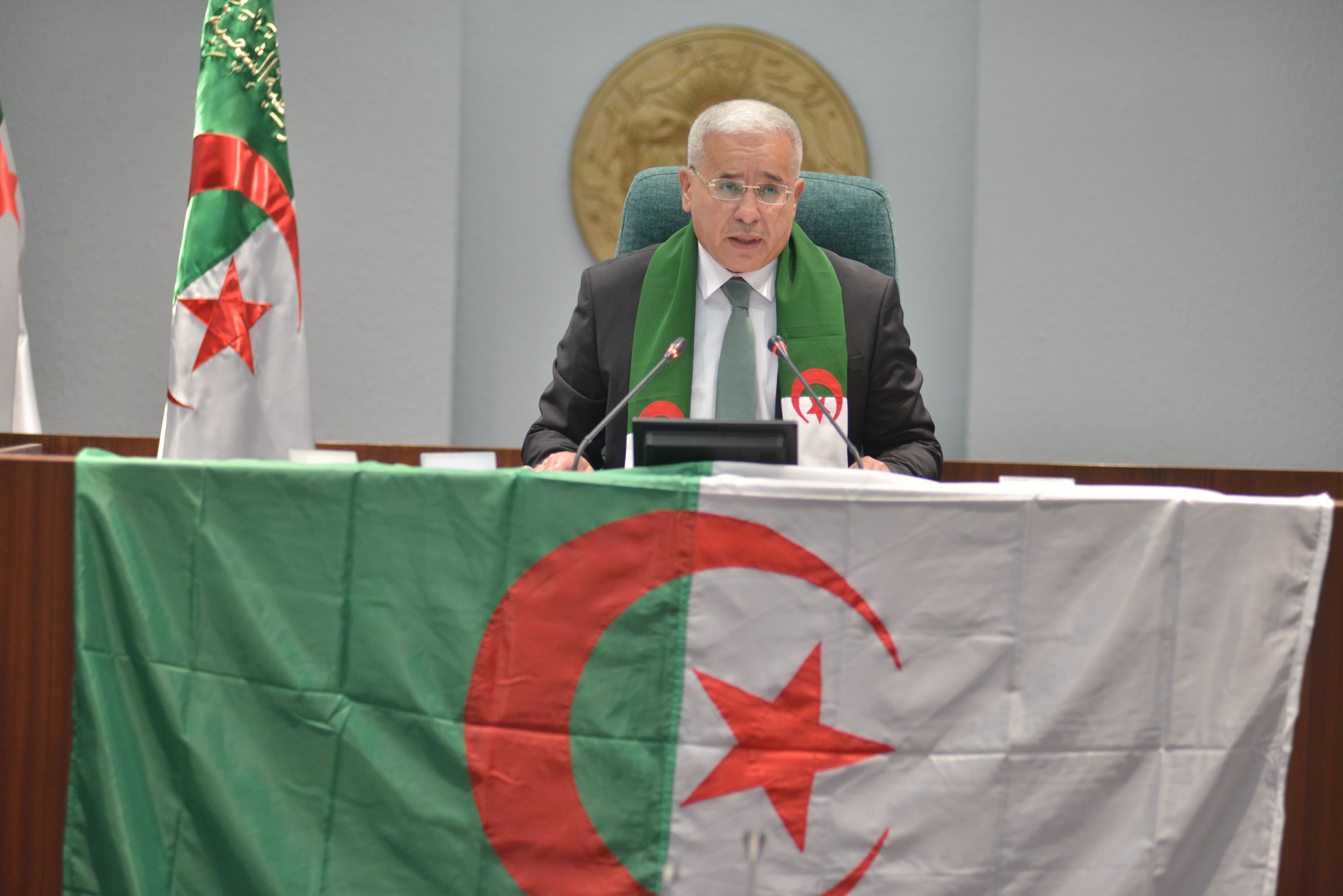
The Speaker of the People’s National Assembly (lower house of Parliament), Brahim Boughali, highlighted on Saturday the importance of the proposed law concerning the criminalization of French colonialism in Algeria, describing the issue as a “cause for the entire nation.”
In a public session held in the presence of government members and representatives of revolutionary family organizations, Boughali, on behalf of the heads of parliamentary groups in the People’ s National Assembly, presented the proposed law concerning the criminalization of French colonialism in Algeria, emphasizing that “the issue of criminalizing colonialism is a cause for the entire nation, transcending political sensitivities and differences.”
Boughali noted that convening this session “is not a routine parliamentary procedure, but rather a sovereign act par excellence, a frank moral stance and a clear political message that expresses Algeria’s adherence to its inalienable right and its loyalty to the sacrifices of its people and to the message of its martyrs.”
He further said that the proposal “goes beyond mere legislation, it is a moment of awareness and loyalty and a milestone in the path of the new Algeria, through which the State, via its legislative body, reaffirms its pledge to national memory.”
Objective of the Proposed Law
He said that this text, which enumerates the crimes of the French colonialism, determines the responsibility of the French State for its colonial past and establishes mechanisms for demanding recognition and apology, with the adoption of penal measures to criminalize the glorification of colonialism or its promotion, “does not target any people nor does it seek revenge or the stirring up of resentments. Rather, it rests on a fundamental principle that crimes against humanity cannot be erased by time, justified by power, or buried in silence.”
A Stand for Truth
This proposal is “an act of fidelity to truth before being a political stance,” in addition to being “a clear message both domestically and internationally that the Algerian national memory is not subject to erasure or bargaining and that building the present and looking forward cannot be based on denying the past or erasing it.”
In his detailed explanation of the proposal, Boughali noted that the aforementioned text is built on legally established international principles, and highlights that French colonialism in Algeria constitutes a State crime for which France bears legal and moral responsibility.
In this regard, he underlined that French colonialism in Algeria was “an integrated project of uprooting and dispossession, as it seized the land, confiscated it, distributed it to settlers, and made the Algerian a stranger in his homeland, deprived of the wealth of his land, excluded from his right to dignified living conditions, under systematic policies of impoverishment, starvation and marginalization, meant to break his will, erase his identity and sever his connection to his historical and civilizational roots.”
Boughali added that this colonial project “did not stop at confiscating land and plundering resources, but extended to policies of exile and forced displacement along with the dispersal of families and the depopulation of villages and hamlets, where Algerians were thrown into harsh camps and detention centers, which formed tools for collective control and breaking the social and cultural bonds of the Algerian people.”
He reflected on the colonial era’s mass massacres and deliberate killings that claimed millions of innocent lives both at home and in exile, compounded by France’s nuclear tests in the Algerian Sahara, which “didn’t simply end when the testing stopped, they left enduring wounds, as well as health and environmental damage that successive generations continue to suffer from, constituting an unambiguous crime that neither expires with time nor can be forgotten.”
Boughali concluded by expressing his pride in the Algerian people “the rightful claimants and guardians of national memory,” describing this legislation as “a fruit of their long struggle and unwavering determination to defend their sovereignty and dignity.”