

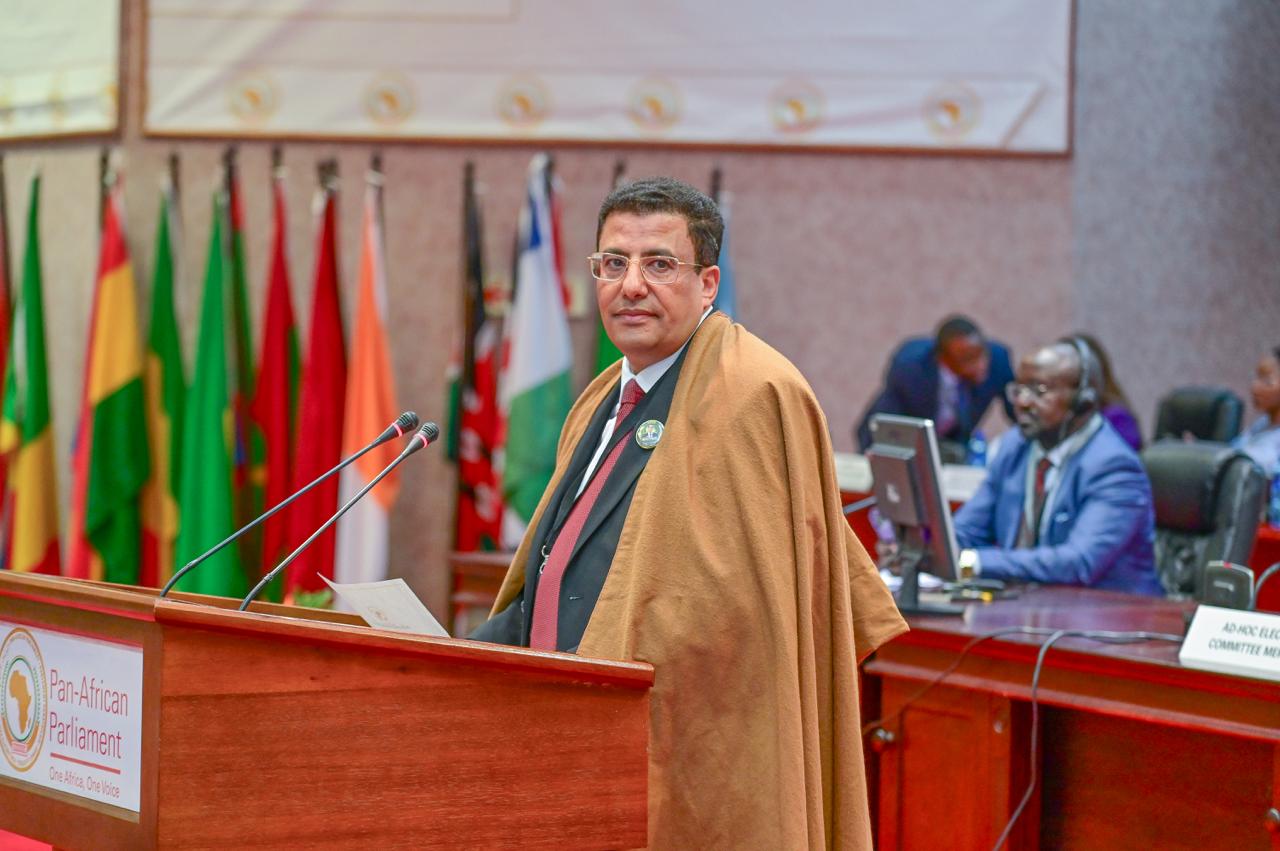
The Algerian candidate, Fateh Boutbig, was elected on Thursday as President of the Pan-African Parliament with 119 votes out of 152, during the extraordinary session of the institution held in Midrand, South Africa, marking a new consecration of Algeria’s diplomatic weight on the continental stage. His mandate at the head of this legislative body of the African Union will run until 2029.
This election represents much more than a simple institutional success; it consecrates Algeria’s political credibility among its African partners and confirms its status as an essential diplomatic power on the continent, despite attempts at disruption led by Morocco, which mobilized all means to block the Algerian candidate by resorting to various practices considered unethical behind the scenes of the continental Parliament.
Victory of a united African will
In his first address after his election, Fateh Boutbig described this success as a “victory of a united African will”, considering that this result reflects the continent’s confidence in a political vision based on unity, integration and African sovereignty.
“There can be no strong Africa without taking into account North Africa, this civilizational and strategic bridge linking the continent to its Mediterranean and global environment,” declared the new President of the Pan-African Parliament.
The Algerian official also stressed that North African countries, with Algeria at the forefront, have the resources and capacities necessary to constitute a real engine of continental integration, particularly in the fields of energy, security and diplomacy.
This victory comes as part of a series of successes achieved by Algerian diplomacy under the leadership of President Abdelmadjid Tebboune, whose international action is gradually strengthening Algeria’s role as a central actor of stability and integration in Africa.
Boutbig also recalled that “Algeria continues to play a central role in supporting African causes, promoting peace, strengthening economic integration and consecrating the principle of African solutions to African problems.”
Limits of Moroccan influence revealed
The vote also revealed, once again, the limits of Moroccan influence within African institutions. Rabat had presented as candidate its former Minister of Tourism and Vice-President of the House of Councillors, Lahcen Haddad, without managing to convince African delegations.
According to several sources present during the proceedings, the Moroccan delegation multiplied pressure tactics and disruptions, notably during meetings of the North Africa group tasked with designating the single regional candidate for the presidency of the Pan-African Parliament.
Led by Lahcen Haddad, the Moroccan delegation reportedly attempted to obstruct the electoral process by exerting pressure on the institution’s secretariat and disrupting deliberations, to the point of requiring intervention by security services to restore order and allow the normal continuation of the proceedings.
Morocco also suffered a setback in all other positions allocated within the North African representation, obtaining no strategic seat, which confirms the growing isolation of Rabat in the face of the consolidation of Algerian influence on the continent.
This election crowns a process initiated during preliminary consultations of the North Africa geopolitical group, during which Fateh Boutbig had already largely prevailed with 19 votes, against only 4 votes for each of his competitors.
Beyond its institutional significance, this victory appears as another demonstration of Algeria’s diplomatic influence in Africa and the growing confidence it enjoys among African capitals, thereby consolidating Algiers’ role as a reference power within continental balances.