

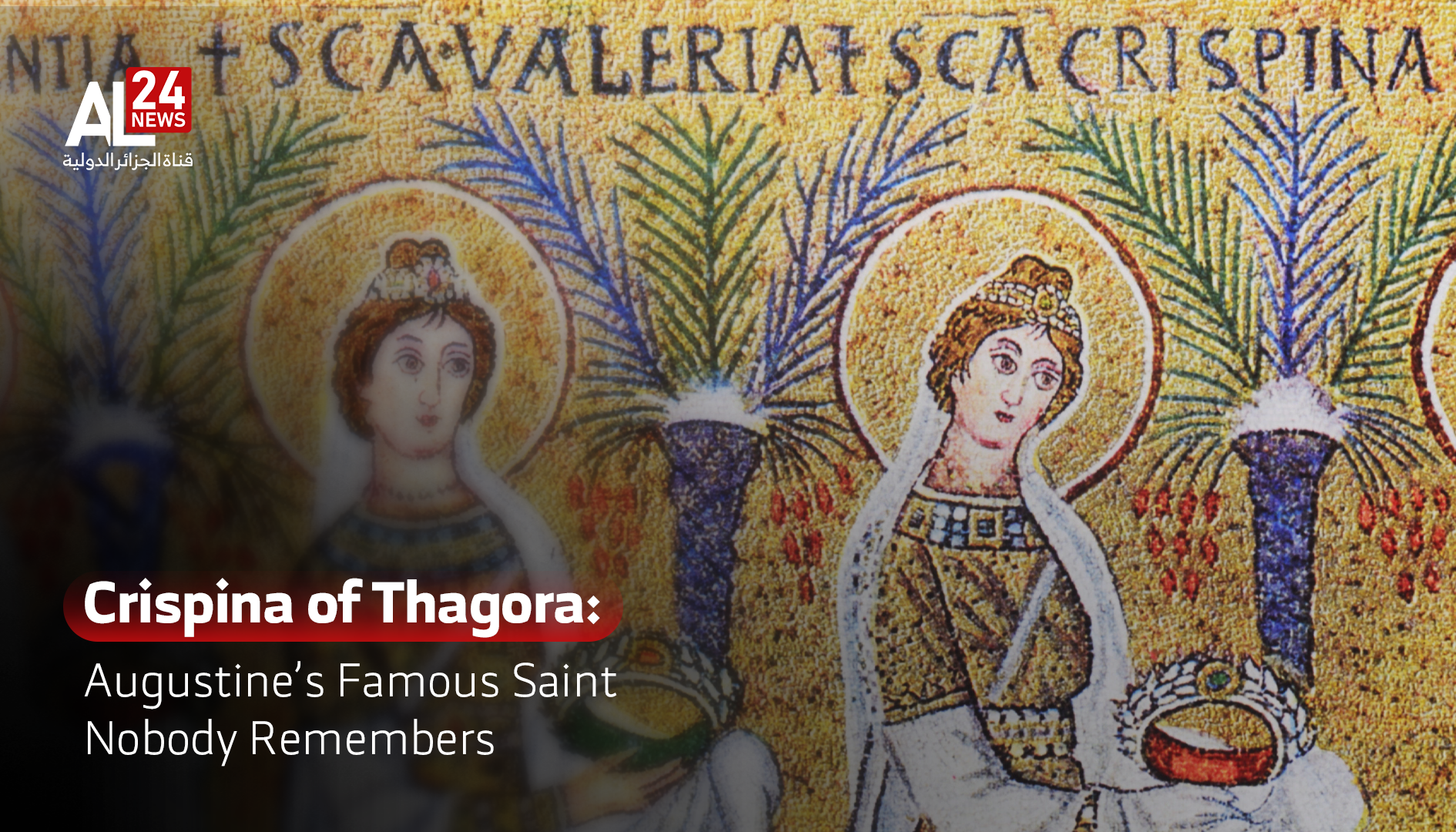
“Is there anyone in Africa who does not know about these events, brothers and sisters? Scarcely, for she was extremely famous, of noble stock and very wealthy,” asks Saint Augustine.
Is there anyone in Algeria or elsewhere in Africa who does know Santa Crispina? The question feels almost inverted today. Augustine speaks as if her name circulates effortlessly through memory. In the present, it barely does. What was once assumed common knowledge has become specialized history, preserved in texts and ruins but detached from everyday awareness. The distance between his certainty and our forgetfulness is the first clue that something has been lost.
So who was this “extremely famous” lady of ancient Algeria, brothers and sisters?
Born in a prosperous agricultural town of Thagora in the third century, (modern Taoura in the Algerian province of Souk Ahras), Crispina belonged to the clarissima class. Of Numidian, Berber origins, she was a wealthy patrician, a married woman with children, and the mistress of considerable estates. In the deeply stratified world of the late empire, hers was a life of insulated privilege, surrounded by the comforts of a highly developed Romano-African culture. Yet, on the 5th of December, 304, she found herself standing before the Roman proconsul Anullinus in Theveste (Tébessa), effectively on trial for her life.
During the Diocletianic Persecution, the Roman state tried to enforce religious conformity. In Roman thinking, refusing sacrifice was not just religious dissent but a political act that threatened the pax deorum, the divine order believed to secure the empire. For the authorities, the defiance of the lower classes was an annoyance, but the defiance of a noblewoman like Crispina was a scandal. It threatened the social order.
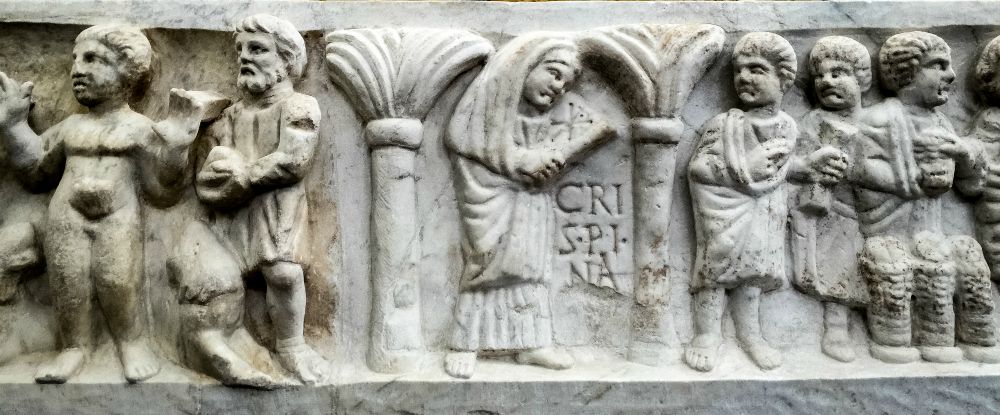
When Crispina was brought into the forum at Theveste, the proconsul Anullinus was waiting, and the trial began:
The clerk: “Crispina, a lady of Thagora, is to be tried at your good pleasure. She has spurned the laws of our lords the emperors.”
Anullinus: “Bring her in.”
Anullinus: “Have you understood the sacred decree?”
Crispina: “I have never sacrificed, and I shall not do so, save to the one true God and to our Lord Jesus Christ, His Son, who was born and suffered.”
Anullinus: “You are a stubborn and insolent woman, and you will soon begin to feel the force of our laws against your will.”
Crispina: “I shall be glad to suffer on behalf of the faith which I hold firm.”
Anullinus: “I will have you beheaded if you persist.”
Anullinus: “All Africa has offered sacrifice.”
Crispina: “May they never find it easy to make me offer sacrifice to demons; but I sacrifice to the Lord who made heaven and earth and sea and all that is in them.”
Anullinus: “You utter blasphemy in not honoring what is conducive to your safety.”
[Her hair was cut and her head was shaved.]
Anullinus: “If you despise the worship of our venerable gods, I shall order your head cut off.”
Crispina: “I should thank God if I obtained this. I should be very happy to lose my head for the sake of my God. For I refuse sacrifice to these ridiculous deaf and dumb statues.”
Anullinus: “So you absolutely persist in this foolish frame of mind?”
Crispina: “My God who is and who abides forever ordered me to be born; it was He who gave me salvation through the saving waters of baptism. He is at my side, helping me, strengthening His handmaid in all things so that I will not commit sacrilege.”
Anullinus: “Why should we suffer this impious Christian woman any further?”
Sentence: “Seeing that Crispina has persisted in infamous superstition and refuses to offer sacrifice to our gods in accordance with the heavenly decrees of Augustan law, I have ordered her to be executed with the sword.”
Crispina: “I bless God who has designed to free me from your hands. Thanks be to God!”
Her death sent a profound shockwave through the social fabric of North Africa. A century later, her memory remained a potent cultural force, carefully curated and amplified by the titan of the region, St. Augustine of Hippo.
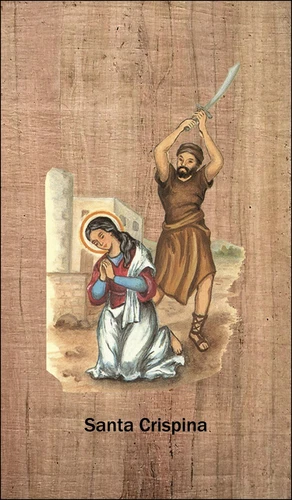
Preaching in North Africa in the late 4th and early 5th centuries, Augustine repeatedly returns to Crispina in his sermons, presenting her as a striking moral example drawn from living memory. “The persecutors raged against Crispina, whose feast we celebrate today; they raged against a rich and delicate woman, yet she was strong, because the Lord was her covering over her right hand, the One who guarded her.”
For him, her significance lies in the reversal of expectations: a privileged woman who does not break under pressure. He drives the point home through repetition, urging his audience to see endurance where others would expect collapse: “Think how Crispina rejoiced: she rejoiced when arrested, rejoiced when hailed before the judge, rejoiced when thrown into prison, rejoiced when hoisted onto the scaffold, rejoiced when the people listened to what she had to say, and rejoiced when she was condemned.”

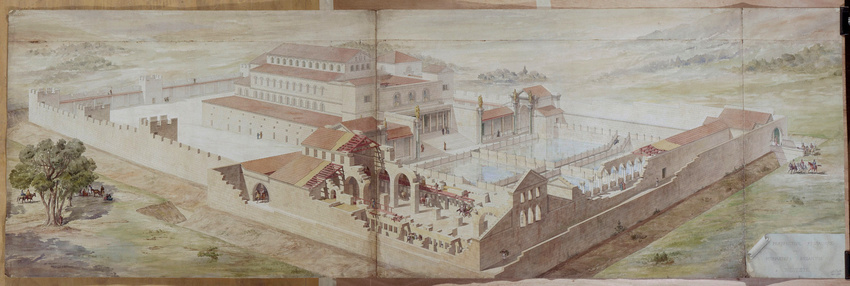
Today, the physical traces of Crispina’s world are quiet. In Taoura, the remnants of ancient Thagora are scattered among modern homes and agricultural fields, bleached by the harsh Algerian sun. In Tébessa, the great ruined basilica, excavated by the French in the 19th century and long thought to be dedicated to Crispina herself, still attracts the occasional visitor who wanders among its geometric mosaics and fallen columns.
Reading her trial in this ancient landscape reveals something enduring. Crispina’s story is more than a footnote of church history; it captures the clash between state power and individual conscience. In the dry lines of a Roman court record, we hear a woman who faced imperial authority, measured it against her beliefs, and chose to stand by them.