
Public Outrage in Morocco Over Controversial Jewish Rituals at Marrakesh’s Historic Walls

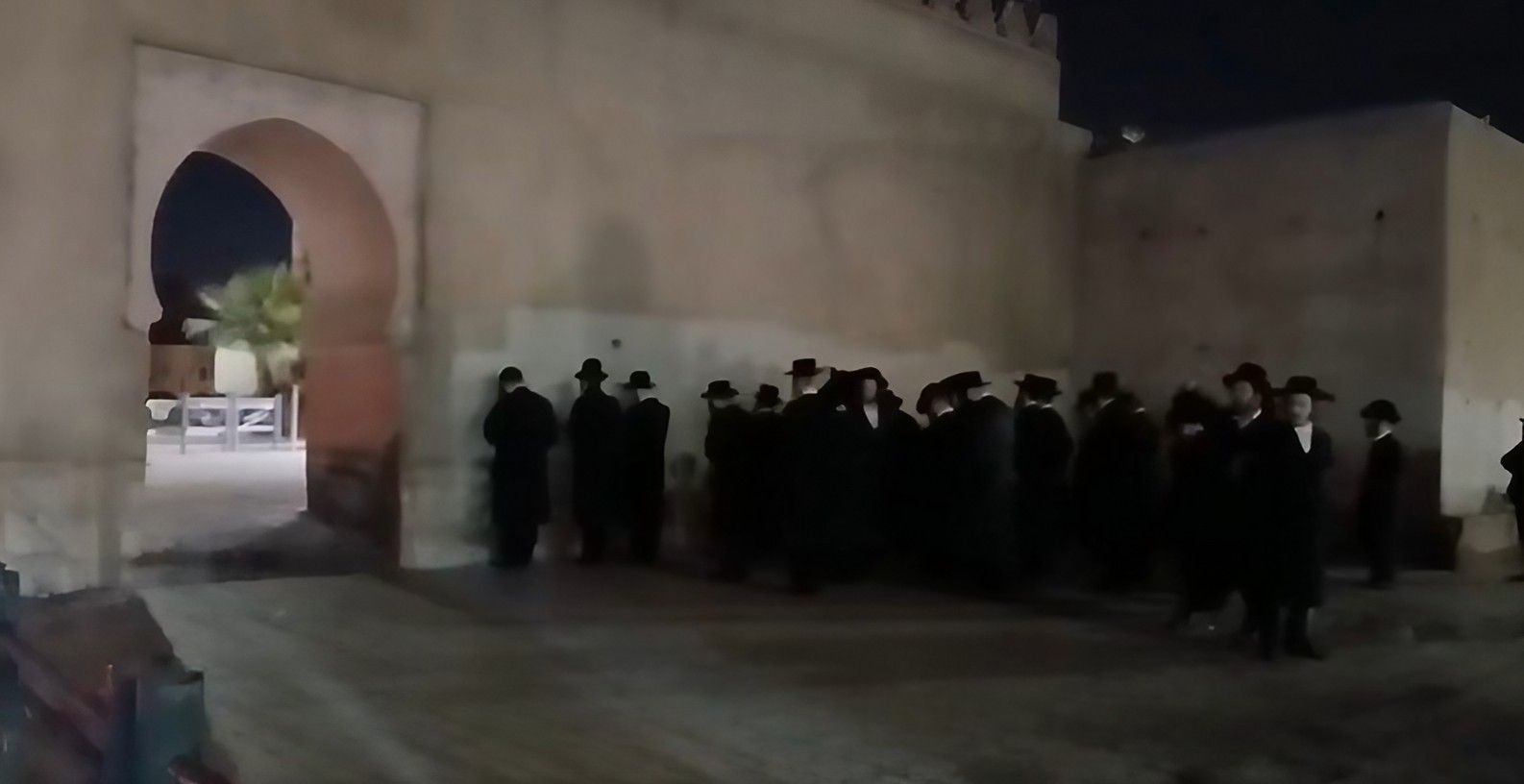
A wave of anger and condemnation has swept across Morocco after a video circulated on social media showing dozens of individuals performing Jewish religious rituals collectively and openly near the historic Bab Doukkala walls in Marrakesh. What stirred controversy was not merely the rituals themselves, but the context in which they took place: a public space, a site of deep historical significance, and a timing that intersects with sensitive regional tensions.
The scene, as many described it, appeared to replicate what is often loosely referred to as the “Wailing Wall” (Al-Buraq Wall, which was seized by Zionists and transformed into a symbolic cornerstone within a political narrative that ultimately resulted in the reality of occupation in Palestine—what began as a ritual evolved into a symbol, then a cause, and eventually an imposed reality in occupied al-Quds). Men dressed in the attire typically associated with ultra-Orthodox Jewish communities including distinctive hats and long coats were seen conducting collective Rituals openly, in a country whose constitution clearly states that Islam is the religion of the state.
This apparent contradiction raises fundamental questions about the limits of tolerance and when it shifts into perceived provocation or encroachment.
More concerning is the ambiguity surrounding the incident: who were these individuals? Did they obtain official authorization? And why was this specific location chosen? The silence of local authorities has only deepened suspicion and fueled speculation. In the absence of transparency, political interpretations gain traction, particularly as some link the incident to the accelerating normalization process, which, they argue, is no longer confined to official relations but is increasingly permeating public spaces in a troubling manner.
Several journalists and analysts have not hesitated to describe the event as a “blatant provocation” and an attempt to impose a new reality under the guise of coexistence. Coexistence, they stress, does not mean overriding historical symbols or disregarding societal sensitivities; rather, it is grounded in mutual respect and adherence to the law. Turning urban landmarks into stages for rituals carrying political overtones, they argue, goes beyond a mere isolated incident.
AL24NEWS