
The Rector of Jamaa al-Jazair: Emir Abdelkader’s Peaceful Philosophy Offers Practical Solutions to Modern Conflicts


The rector of Jamaa al-Jazair, Sheikh Mohamed Maamoun Al Kacimi El Hassani, confirmed on Monday that the peaceful ideology of Emir Abdelkader can be translated into practical solutions for the challenges of the present age, which is suffering from increasing ethnic and sectarian conflicts in a fragmented world, experienced by many due to extremism and bloody wars.
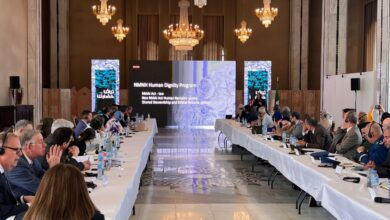
In a lecture titled “The Legacy of Emir Abdelkader in Peacebuilding in a Fragmented World,” delivered at the Oxford Centre for Islamic Studies, and attended by the center’s director, Dr. Farhan Nizami, the rector of Jamaa al-Jazair emphasized that the Emir’s principles remain a beacon for those seeking peace, guiding them toward understanding, cooperation, and harmony.
“This reactivation of a historical reference figure prompts us to believe that the positivity he embodies, at a great cost as we know, is not limited by time; that it is a resource still available to be drawn upon whenever the need arises. And indeed, it is being summoned here today, by the grace of God, on this historic occasion that brings together the constellation of scholars and bearers of pen,” Sheikh El Hassani said.
The rector also highlighted that recalling Emir Abdelkader today should not be confined to viewing him solely as a military leader or an ascetic mystic, for he was “a polymath intellectual who left a rich legacy in thought, politics, literature, and religion.”
“His legacy could be transformed into an academic curriculum, a field of scholarly research, and a source of civilizational inspiration that illuminates the principles of sincere and serious communication, as a foundation of fruitful cooperation between the world’s people,” Sheikh El Hassani added.
In his lecture, the rector of Jamaa al-Jazair spoke in detail about the remarkable and singular journey of Emir Abdelkader—a legacy acknowledged by French officers and European statesmen alike, who expressed deep respect for the Emir. To them, he was far more than a military leader; he was a man of principles and values. Among those who praised him was the French General Lamoricière, who said, “Abdelkader was a noble enemy, rare to find, he fought with courage, respected his opponent, and treated prisoners and the wounded with a humanity that sometimes embarrassed us.”
The Emir, according to the rector, was a statesman, not a man of power, who chose a visionary approach, and at the heart of his resistance was a state-building project based on a comprehensive legal and organizational framework. Moreover, he knew when to resist, when to negotiate, when to make treaties, and when to forge peace. Eventually, his efforts earned him recognition from world leaders, ranging from the Ottoman Sultan to Queen Victoria and Napoleon III of France.
Sheikh El Hassani emphasized that what makes Emir Abdelkader’s philosophy relevant to our contemporary world is his ability to harmonize the spiritual and practical aspects of his peacebuilding vision. For the Emir, “true peace is not built on bias and bigotry, but on justice and benevolence; that human brotherhood must take precedence over narrow affiliations when people’s lives are at stake.”
According to Emir Abdelkader, peace should be based on “justice, mutual respect, and recognition of the other as fully human, regardless of religion, race, or language,” which is a philosophy based on “unity in diversity.” Thus, multiplicity becomes a richness, not a flaw.
“There can be no peace without justice, no justice without mercy, and no mercy without recognizing the full humanity of others,” the rector said, citing Emir Abdelkader.