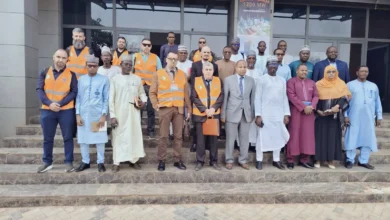
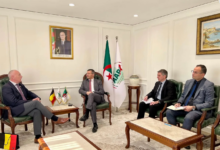
Algerian Minister of State, Minister of Foreign Affairs, National Community Abroad, and African Affairs, Ahmed Attaf, said on Tuesday that the 12th edition of the Oran Process has held special significance, as it shone a spotlight on the key security and political challenges currently facing the African continent.
In his closing remarks at the 12th edition of the High-Level Seminar on Peace and Security in Africa, Ahmed Attaf expressed his “deepest gratitude and sincere appreciation” for the strong presence, outstanding participation, and unwavering commitment of attendees, praising their efforts to keep “the flame of this process burning brightly, illuminating the path towards safeguarding peace and stability in Africa.”
He also highlighted the notable participation in this edition, which, for the first time since the launch of the Oran Process, included representatives from non-African countries elected to the United Nations Security Council.
These include the Kingdom of Bahrain, the Republic of Colombia, and the Republic of Latvia, to whom he extended “heartfelt congratulations” on their election, wishing them “every success in fulfilling their roles and contributing to international peace and security.”
Attaf said that such a high-level and significant participation stands as a clear testament to the broad resonance and growing attention that the Oran Process is receiving on both the continental and international levels.
“Algeria views this renewed and growing momentum as a source of pride and motivation, as it leads this continental endeavor aimed at unifying Africa’s voice and strengthening its influence and impact in the United Nations Security Council and in all multilateral international forums,” Attaf said.
Africa on Alert
The Algerian Minister emphasized this session’s special significance, noting that it shone a spotlight on the key security and political challenges currently facing the African continent. “These challenges are both concerning and alarming, requiring us to sound the alarm and awaken our collective sense of duty and responsibility.”
Attaf indicated that these challenges are currently manifested in a range of major risks that feed into one another, forming a triad that dominates the security landscape of the entire continent. This triad consists of unconstitutional changes of government, the scourge of terrorism, and the phenomenon of external interferences.
He explained that the unconstitutional changes of government have unfortunately become a common sight in Africa, to the extent that the continental organization was recently forced to suspend the membership of two countries within a short span of just forty-two days. Moreover, the scourge of terrorism has worsened and spread, to the point that it now imposes itself as the most significant threat in the Sahel region, where it controls vast territories and has established itself as a de facto authority. Furthermore, the external interferences have overshadowed most areas of tension, crisis, and conflict in Africa, to the point where the keys to resolution are often in the hands of foreign actors rather than local stakeholders, who should be the ones holding the sovereignty and the decision-making power.
African-Led Solutions
In the face of this crisis, Ahmed Attaf underscored the imperative to reposition the African Union as a central actor in crisis prevention and conflict resolution, stressing that the principle of “African solutions to African problems” is today not only a legitimate ambition but also a strategic choice that will shield the continent from the current international polarization, which only leads to the reproduction of crises, in more severe and dangerous forms.
From this perspective, Attaf said that strengthening the complementarity between the African Peace and Security Council, on one hand, and the African members of the United Nations Security Council, on the other, becomes crucial. “This subject was the focus of a substantial portion of our discussions during this edition of the Oran Process.”
“While our African Council must improve its performance in addressing peace and security issues on the continent, the three African members of the United Nations Security Council must also ensure that their efforts align and extend the outcomes of their work to the global level,” he said.
United African Voice
Attaf highlighted that Algeria’s experience, along with the experiences of African counterparts in the Security Council, has confirmed the “importance of strengthening the integrative and existential link between our continental organization and its representatives in the United Nations Security Council. These experiences have proven, and continue to prove, that the key differentiator lies in a single choice: the choice of unity.”
In this context, he reiterated that the unity of the African Peace and Security Council creates the unity of the African members of the United Nations Security Council. Additionally, the unity of the African group in the United Nations Security Council gives it weight, credibility, strength, and stability in the face of external pressures, polarization, and divisions. He further stressed that this unity gives the African group a powerful voice, a decisive stance, and significant influence whenever it comes to matters of peace and security in Africa.
“Maintaining African unity, both in terms of cohesion and voice, has been at the heart of our objectives during Algeria’s tenure in the Security Council,” Attaf said.
Highlighting that the principle of African unity encapsulates the essence of Algeria’s experience in the United Nations Security Council, Attaf concluded his speech by recalling the words of the late African leader, Julius Nyerere, who said, “Unity may not make us rich, but it will make it difficult for Africa and for the African peoples to be disregarded.”