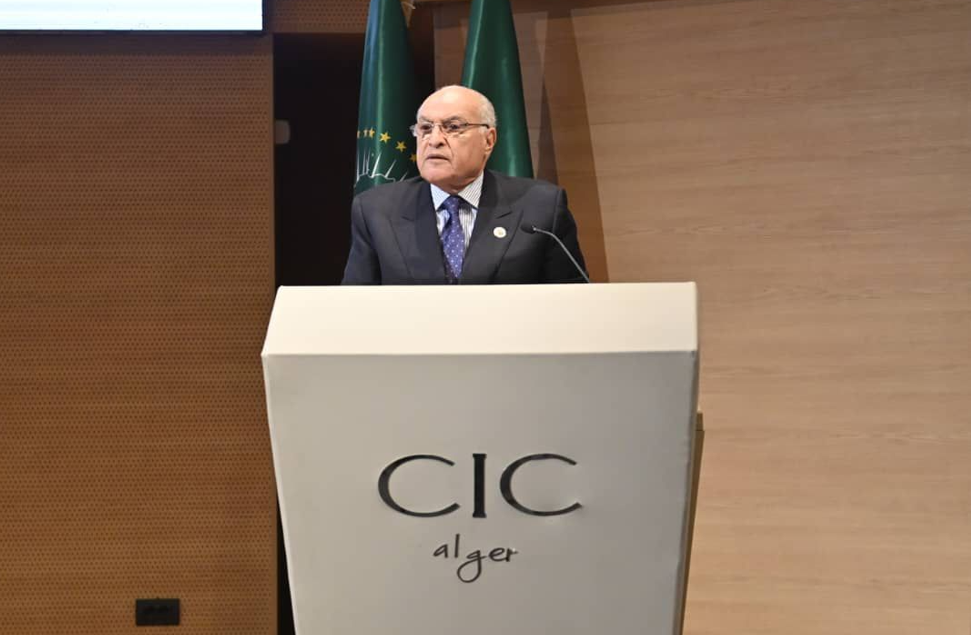
Algerian Minister of State, Minister of Foreign Affairs, National Community Abroad, and African Affairs, Ahmed Attaf, emphasized on Sunday that the International Conference on the Crimes of Colonialism in Africa is convened not to lament the past, nor to dwell on suffering, nor to stir up resentments, but to uphold rights, to call things by their proper names, and making the world fulfill its responsibilities.
In his opening statement, Ahmed Attaf said the conference revolves around the central theme chosen by the African Union for this year’s ordinary session: “Justice for Africans and People of African Descent,” to delve into a specific issue —the question of “Criminalizing Colonialism in Africa.”
“I extend my greetings to you all on behalf of the President of the Republic, Mr. Abdelmadjid Tebboune, under whose high patronage this conference is being held, and in close coordination with the African Union Commission. President Abdelmadjid Tebboune played a key role in proposing the initiative to organize this international forum during the last ordinary summit of the African Union earlier this year—an initiative that was unanimously endorsed and warmly welcomed by his African brothers,” Attaf said.
At the outset of his speech, the Algerian Minister recalled the words of the martyr Didouche Mourad, one of the initiators of the November Revolution: “Should we fall on the battlefield, the defense of our memory becomes a solemn charge upon you.”
“We gather to follow in the footsteps of our ancestors—ancestors who stood firm, persevered, resisted, and triumphed; ancestors who transformed resistance into revolutions, revolutions into epic deeds, and epic deeds into miracles; ancestors who liberated lands and nations and lifted from their peoples the chains of slavery and oppression,” he added.
Advancing Africa’s Historical Justice:
In this regard, Attaf underscored that Africa has realized that addressing the legacies of colonialism has become an imperative for steadfastly and resolutely continuing the path toward building a future founded on dignity, pride, justice, and equity.
He noted that by launching this project to achieve historical justice, Africa affirms that its struggle continues as long as attempts persist to erase history, distort the truth, and falsify facts, while the crimes of colonialism have not received explicit and responsible acknowledgment. Moreover, the colonial phenomenon itself has not been designated in the records of international law for what it truly is—an abhorrent and disgraceful crime, one that admits neither limitation, neglect, nor forgetfulness.
Accordingly, Minister Attaf shed light on the fact that colonialism inflicted a setback that excluded the African nations from the course of human history and deprived them of contributing to its making.
“In the broader march of humanity toward civilization and progress, colonialism represented the greatest regression and the most severe setback in this journey.”
He noted that colonialism halted the process of building Africa’s nation-states and deprived them of completing it in a way that would have enabled peoples to exercise full sovereignty over determining their own destiny. Additionally, he stressed that colonialism was never a civilizing mission; at its core, it was nothing but plunder, domination, and exploitation.
“The reality of colonialism is that it prematurely brought together the gravest crimes now condemned across the globe: the crime of aggression, the crime against peace, the crime against humanity, the crime of war, and the crime of genocide,” Attaf said.
A Memory That Defies Time:
The Algerian Minister emphasized that the African collective memory does not forget that the Age of Enlightenment, which illuminated Europe in the eighteenth century, cast over Africa a dark shadow of oppression, subjugation, and tyranny through colonialism. He further stressed that this memory remembers that colonialism was the spark that excluded Africa from all political, economic, technological, scientific, and social revolutions—revolutions from which the rest of humanity benefited.
“Indeed, African memory does not forget; it refuses to forget,” Attaf said, highlighting what colonialism left behind in the Congo: the genocide of half the population and the enslavement of the rest. In Cameroon: the genocide of the Bamiléké people and heinous crimes that shock the conscience—villages burned, heads severed, and experiments with poisonous gases. In Namibia: the genocide of the Herero and Nama peoples. In addition to Angola, Mozambique, Madagascar, and the other African countries “touched by the hands of the accursed colonizer—or rather, the tyrannical oppressor.”
Algeria’s Unparalleled Struggle Under Colonialism
Ahmed Attaf noted that at the heart of this collective memory, Africa preserves the bitter ordeal of Algeria as a rare example, unparalleled in history in its nature, character, and practice. “French colonialism in Algeria was not merely what could be called exploitative colonialism; it was settler colonialism in every sense of the term.”
He emphasized that, “This colonial project was the longest and most violent settler-colonial project in modern history! One hundred and thirty-two years of colonialism! One hundred and thirty-two years of uninterrupted Algerian resistance! One hundred and thirty-two years of French colonial crimes in all their forms—without truce, without mercy, and without restraint!”
“Every inch of this sacred land bears witness to the brutality, cruelty, and tyranny of the French colonizer—from the stage of the invasion, which lasted more than seven decades, to the era of organized popular resistance, and finally to the triumphant War of Independence, the November Revolution, which endured seven and a half years. During this revolution, Algeria offered its finest sons and daughters—one and a half million martyrs—as a sacrifice on the altar of freedom and dignity,” Attaf said.
The Minister then recounted the massacres that accompanied every move of the French colonizer since the start of the colonial campaign in 1830: from the massacres at Zaatcha in 1849, to the massacres in El-Ghwat in 1852, to the Kabylie massacres in 1857; through the scorched-earth policies aimed at breaking the resistance and its popular base, as well as the looting and confiscation of lands and property to be handed over to European settlers; not to mention the discriminatory and racist system of the Indigénat law between 1881 and 1945; up to the massacres of 8 May 1945, and the collective exterminations, organized massacres, and military campaigns of regroupment and relocation during the War of Independence between 1954 and 1962.
These campaigns forcibly displaced between two and three million Algerians—about a third of the population. He added that what has been presented is only a glimpse of the horrors that Algeria endured throughout the French colonial period, a legacy that the Algerian desert still bears today in the scars of French nuclear tests and their remnants in its sands.
The Responsibility That Binds Us:
Ahmed Attaf reiterated that, based on its bitter experience, Algeria fully identifies with the core objectives set by the African Union for the initiative to achieve historical justice. Africa has every right to demand official and explicit recognition of the crimes committed against its peoples during the colonial era—this being the very least that can be expected and the necessary first step toward addressing the legacies of that period, for which African states and peoples continue to pay a heavy price in terms of exclusion, marginalization, and underdevelopment.”
Attaf added that Africa has every right to demand the legal and unequivocal criminalization of colonialism. He noted that just as the international community in the past criminalized slavery, slave-like practices, and apartheid, the time has come to criminalize colonialism itself, rather than merely condemning some of its practices and consequences.
Attaf went on to affirm that Africa has the full right to claim fair compensation and the return of stolen property, for justice cannot be satisfied with empty words or false promises. He underlined that compensation is not a gift or a favor—it is a legitimate right enshrined in international law and universally recognized norms.
He emphasized that the time has come to address and settle the legacies of colonialism in all their dimensions and manifestations, and that we ‘must not’ ignore the necessity of fully dismantling colonialism itself.
In this context, Attaf expressed his deepest solidarity and support for the people in Western Sahara, as they strive to exercise their legitimate and lawful right to self-determination, in accordance with international law and UN principles regarding the decolonization process, and likewise extended support to the Palestinian people—in Gaza, the West Bank, and occupied Jerusalem.
“What unites us today is not merely a slogan to be raised, but a trust upon all our shoulders—a trust we have no choice but to fulfill, absolute and binding. Let us truly be worthy of this trust, worthy of the sacrifices of all our noble ancestors, and worthy of writing a new chapter that honors our history, uplifts our dignity, and illuminates our future,” Attaf said.