The Algerian Presidential Election: Key Points of Candidate Abdelali Hassani Cherif’s Program
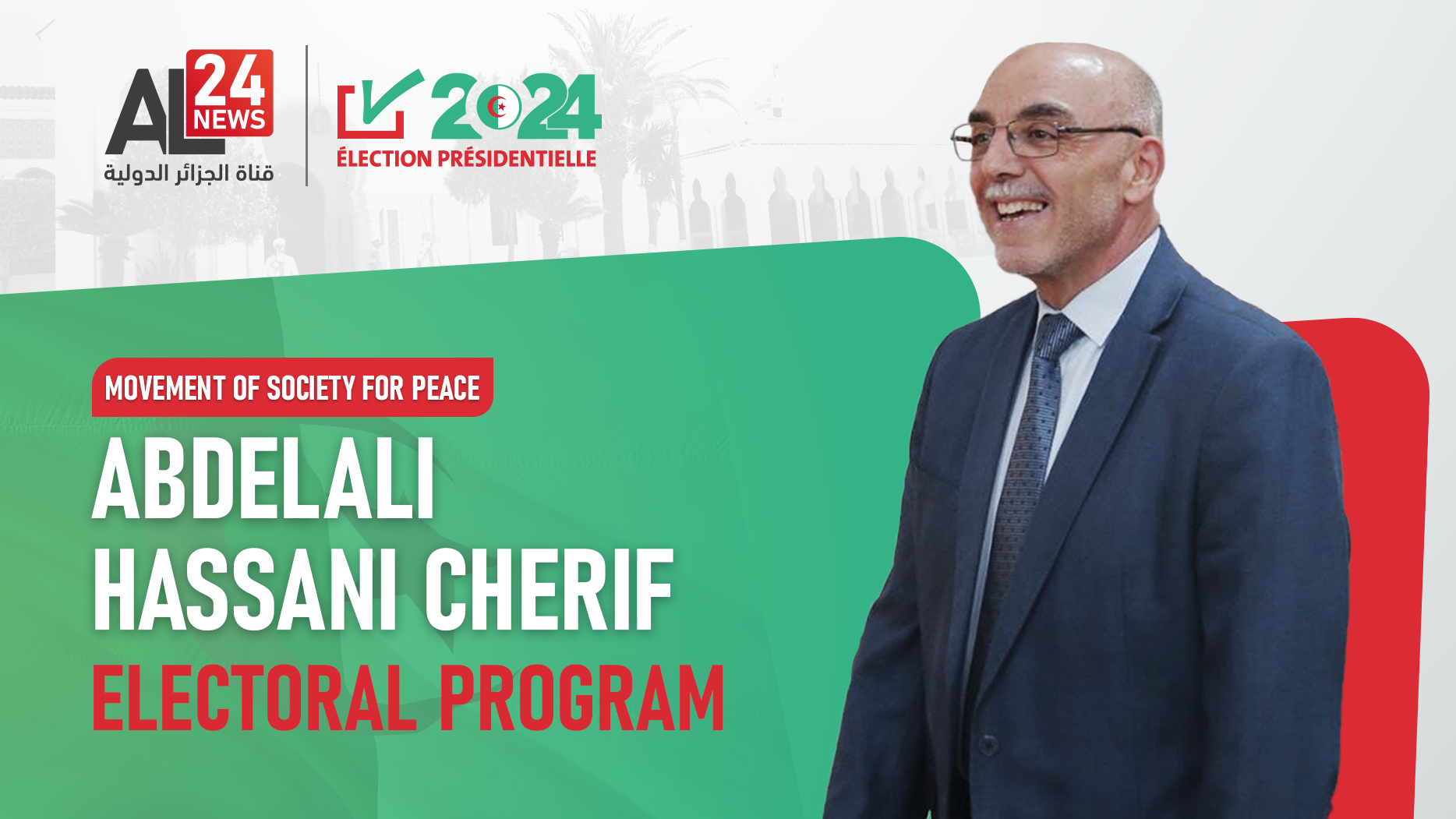
The candidate Abdelali Hassani Cherif has outlined his presidential program titled "Opportunity," which includes five priorities and five key areas. This program comprises 62 commitments covering politics, economy, diplomacy, social issues, and more.

Political Reforms and “Strengthening the Rule of Law”
Hassani Cherif’s electoral program emphasizes the priority of “reforming the political system and achieving broad political partnership.” It aims at establishing a “comprehensive and balanced democratic political system based on popular will, encouraging wide participation, maintaining the Algerian identity, protecting rights and freedoms, defining duties and responsibilities, achieving justice, and ensuring the separation of powers.”
The proposed political reforms under the “Opportunity” program include:
– Reforming the governance system through constitutional, legislative, and institutional improvements.
– Establishing good governance principles and adopting electronic administration.
– Constitutionalizing the criminalization of attacks on freedoms and ensuring actual separation and balance of powers.
– Deepening accountability and oversight of public authority performance.
– Simplifying the procedures for establishing political parties and associations, and reviewing related laws.
– Expanding the parliamentary oversight role and deepening judicial sector reforms.
– Reforming the electoral representation system and supporting the powers of elected local councils.
– Reforming local monitoring, oversight, and financial systems, as well as the evaluation of public policy.
Revising Social Support Policies and Diversifying Housing Solutions
The “Opportunity” program proposes a number of measures for tackling social issues and improving the living conditions of Algerian citizens, including:
– Fair distribution of wealth by revising methods of supporting the poor and middle-income groups.
– Gradual review of the minimum wage and pension amounts.
– Reactivating social dialogue to distribute surpluses to workers in the economic sector.
– Addressing inflation by balancing immediate and strategic measures.
– Implementing regular census mechanisms for the citizens’ incomes and assets.
– Adopting a national system to define levels and forms of support.
– Enacting deterrent measures for misleading declarations and linking support to professional or social activity.
– Linking the implementation of support and assistance with the gradual evolution of prices, as well as tying support and assistance, outside cases of complete disability, to professional or social activity.
As for housing, the program includes:
– Continuing to expand and diversify housing products in line with the citizens’ capacities.
– Updating and improving housing quality and standards.
– Developing mechanisms to support and promote rural housing.
– Stimulating a diverse rental market to encourage real estate investment.
– Diversifying sources and methods for housing construction and financing.
– Implementing measures to encourage renting vacant homes.
Establishing Foundations for a Free Social Economy
In the “economic development” area, Hassani Cherif aims at “establishing the foundations of a free, diverse, and sustainable social economy, liberated from rent-seeking approaches, centered on human factors, based on participatory methods, ensuring efficiency, and providing well-being for Algerians through balanced rapid growth standards, an attractive business environment, and wealth-creating investments.” In addition to ‘raising growth standards,’ this involves increasing Gross Domestic Product (GDP) to around $450 billion, raising per capita income to $9,000, reducing the unemployment rate to 5%, lowering the inflation rate to 3%, increasing the growth rate above 7%, and reviewing the mechanisms for estimating the value of the dinar with integrated approaches.
The electoral program includes a national food security plan aimed at developing strategic crops and achieving comprehensive self-sufficiency. It also involves establishing a system for the inventory and creation of major agricultural hubs that are both climate and economically integrated, and encouraging the creation of integrated groups in the fields of adaptation and food industry. Additionally, the program focuses on developing industrial crops and high value-added products, advancing the processing industries for agricultural products, and supporting and expanding mountain agriculture.
Enhancing Algeria’s International Centrality and Developing Defense Capabilities
The electoral program of candidate Abdelali Hassani Cherif includes a priority of “enhancing Algeria’s centrality in the international arena,” increasing its positive impact within its regional environment, and strengthening its openness and beneficial partnerships. It also focuses on protecting Algeria against various threats, starting with bolstering internal frontiers and enhancing self-defense against infiltration attempts, safeguarding its intellectual and cultural security, affirming national consensus on just causes, and enhancing national security and defense capabilities.
In this context, the program encompasses developing military capabilities and wartime readiness, continuing to upgrade human resources through specialized training schools, and advancing military manufacturing and technological control. It also includes measures to enhance national security by extending its scope to the security of neighboring countries, striving for security stability in neighboring nations, supporting military cooperation, developing preventive defense, intelligence capabilities against external threats, and strategic vigilance tools.
Regarding “supporting just causes,” Hassani Cherif’s program emphasizes advancing global liberation causes, particularly the Palestinian cause, reaffirming support for it until liberation, actively contributing to the reconstruction of Gaza, and supporting the Sahrawi people’s right to self-determination.
Promoting University Competitiveness and Reviving the Reformative Role of Mosques
In the fifth section titled “Cultural Development,” the program addresses ways to advance knowledge and sciences, encourage scientific research, reinforce national identity, promote cultural heritage, activate the role of national memory, and stimulate creativity and innovation. Hassani Cherif proposes mechanisms to enhance and monitor the global competitiveness of Algerian universities, align university work with development needs, update the legal framework for the sector to enforce standardization criteria, encourage private sector contributions to higher education, activate quality cells in research and scientific publishing, and evaluate the “LMD” educational system.
Additionally, Hassani Cherif has committed to revitalizing the educational and reformative role of mosques by valuing and protecting the role of imams, enhancing their status in society, and strengthening the role of regional scientific councils.