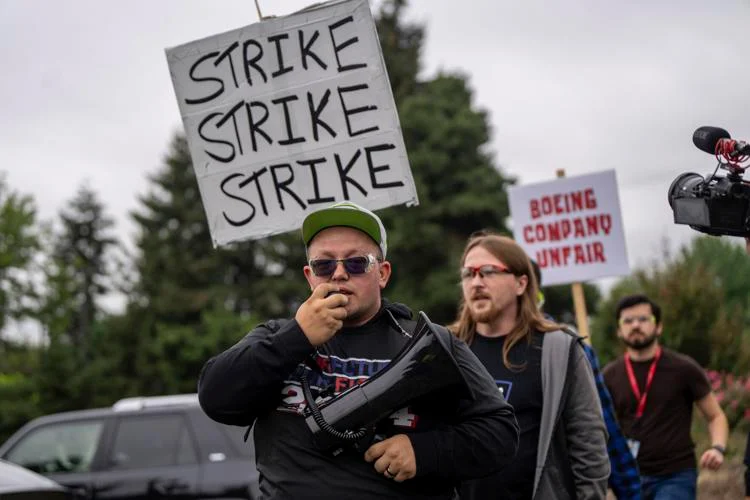
More than 33,000 Boeing workers involved in the production of the bestselling 737 MAX and the large aircraft 777 cast their votes on Thursday regarding a proposed new collective bargaining agreement and the possibility of striking to secure better working conditions.
The results are expected later this evening. The last strike took place in 2008 and lasted for 57 days.
“We have achieved everything we could during these negotiations,” stated Jon Holden, president of the IAM-District 751 machinists’ union. “We recommend ratification because we cannot guarantee that we will obtain more by striking,” he emphasized.
However, in an interview with the Seattle Times published Monday night, he remarked, “I think our members will approve the strike.”
A simple majority is required to ratify the agreement announced on September 8, while a two-thirds majority is necessary to initiate a work stoppage when the current contract expires at midnight on Thursday, after 16 years.
If the collective bargaining agreement is rejected but the threshold for a strike is not met, it will be ratified “by default” according to union rules.
This new agreement, which applies to IAM members in the Seattle region, proposes a 25% pay increase over four years along with commitments for local investments. It also includes plans to construct the next airplane—set to be unveiled in 2035—at the company’s historic base, ensuring jobs for several decades.
Boeing hopes that these concessions will be sufficient to avoid a strike, especially given its precarious financial situation following the crashes of two 737 MAX 8 aircraft in 2018 and 2019, which resulted in the deaths of 346 people, along with numerous quality control issues in production.
“It’s no secret: our business is going through a tough time, partly due to our past mistakes. A strike would jeopardize our shared recovery,” warned Kelly Ortberg, who succeeded Dave Calhoun as CEO on August 8.
He urged employees not to “sacrifice” future progress due to “frustrations stemming from the past.”
A strike would halt production of the 737, 777, and 767 freighter models, which are already experiencing significant delivery delays. This situation is particularly critical since the manufacturer receives approximately 60% of payment upon delivery of the aircraft.
Dissatisfied workers argue that the proposed wage increase falls short of the union’s original demand of 40% and that the pension provisions are inadequate.
Stephanie Pope, president of Boeing Commercial Aviation (BCA), defended the agreement, highlighting it as the largest pay increase ever granted despite the company’s debt of around $60 billion.
“We have offered the maximum possible,” she asserted.
IAM regulations stipulate that striking workers receive $250 per week starting from the third week of their work stoppage.