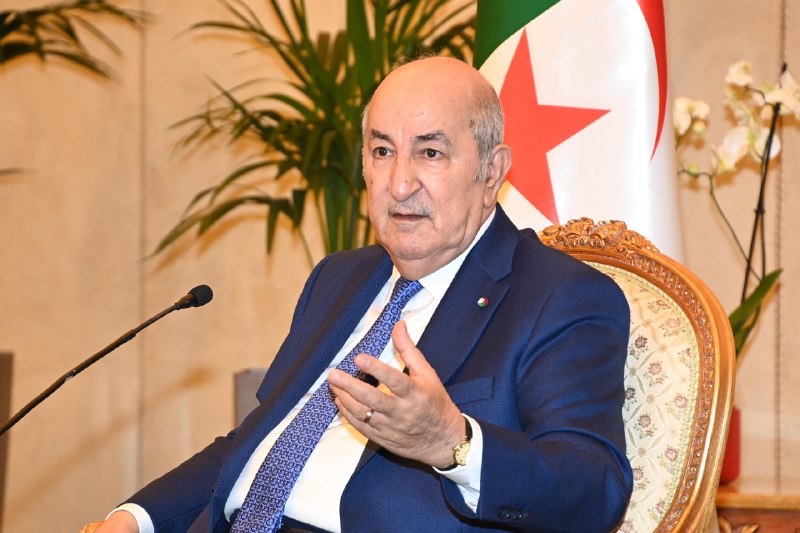
On Wednesday, Algerian President Abdelmadjid Tebboune emphasized that Algeria—a dignified, resilient, and victorious nation—is committed to shaping its present while striving for sustainable development. He firmly rejects any notion that the memory of its past could be neglected or overlooked.
In a message commemorating National Memory Day, which marks the 80th anniversary of the May 8, 1945 massacres, the President stated, “Algeria, in its dignity and strength, is laying the foundation for its present and is determined to pursue sustainable development. This effort is driven by the patriotic will of citizens devoted to their country, who are working diligently during this crucial phase to harness their capabilities to affirm Algeria’s position both regionally and globally. This endeavor is supported by a historical legacy that instills pride in the Algerian people, characterized by courage and a commitment to the principles of justice and freedom.”
He further asserted, “In steadfastness to the rights of its people, in recognition of the sacred legacy of resistance and struggle, and aligned with the message November and the enduring message of our martyrs, Algeria categorically rejects any attempt to allow the memory of its past to fade into oblivion or be denied.”
The President noted that the Algerian people, who have transformed suffering and sacrifice into glory, will not be deterred by challenges; rather, they will grow ever more resolute in opposing those who threaten our principles and independence, thwarting their schemes.
He added that this progress is achieved through “ongoing advancements in major infrastructure projects across all regions and by implementing a strategy that steers our economy onto a path of prudent investment in Algeria’s vast resources, thereby enhancing the welfare of the Algerian people.”
On this occasion, the President highlighted that the Algerian people proudly commemorate this anniversary, which signifies “a pivotal popular uprising, bringing the struggles of the national movement closer to a historic turning point and the transition to armed conflict—an unavoidable means of liberation from a brutal colonialism marked by over a century of horrific violations against the Algerian people.”
He remarked, “The demonstrations of May 8 stand as a true expression of the Algerian people’s attachment to freedom, dignity, and pride, as they faced some of the most atrocious acts of genocide and crimes against humanity in modern history, sacrificing more than 45,000 martyrs for the sake of freedom and liberation.”
He considered that “commemorating this painful anniversary with loyalty to our ancestors, who endured devastating hardships and tragedies, represents a commitment to preserving the legacy of the martyrs. It embeds within our collective consciousness the essence of national identity, shaped by the actions and struggles of generations connected through communication and united by a love for the homeland.”
The President concluded by stating that “this poignant moment, which recalls the martyrdom of tens of thousands of the bravest sons of this nation in Sétif, Kherrata, Guelma, Ain Temouchent, and elsewhere, stands as a testament to the deep-rooted nature of the Algerian people, who honor their history, homeland, and freedom.”