Financial markets rebound after U.S.-China tariff breakthrough

The United States and China have agreed to temporarily slash reciprocal tariffs in a deal that surpassed expectations as the world’s two biggest economies seek to end a damaging trade war that has stoked fears of recession and roiled financial markets.
The U.S. will cut extra tariffs it imposed on Chinese imports in April this year to 30% from 145%, and Chinese duties on U.S. imports will fall to 10% from 125%, the two countries said on Monday. The new measures are effective for 90 days.
The dollar rose against other major currencies, and stock markets lifted following the news, which helped allay concerns about a downturn triggered last month by U.S. President Donald Trump’s escalation of tariff measures aimed at narrowing the U.S. trade deficit.
Moreover, the Chinese yuan CNY=CFXS strengthened to as much as 7.2001 against the dollar to reach a six-month high, while its offshore counterpart CNH= rose more than 0.5%.
China’s blue-chip CSI 300 Index .CSI300 closed up 1.2% and the Shanghai Composite Index .SSEC added 0.8%.
“The result far exceeds market expectations. Previously, the hope was just that the two sides can sit down to talk, and the market had been very fragile,” said William Xin, chairman of hedge fund Spring Mountain Pu Jiang Investment Management in Shanghai.
“Now there’s more certainty. Both China stocks and the yuan will be in an upswing for a while.”
The pan-European STOXX 600 index .STOXX rose 0.9% as of 0853 GMT. Other regional indexes also rose, with Germany .GDAXI up 1.1%, Spain .IBEX rising 0.7%, and the UK .FTSE gaining 0.5%.
“European markets are riding with joy…except for the FTSE 100…that is under pressure due to its exposure to pharmaceutical companies,” said Ipek Ozkardeskaya, senior market analyst at Swissquote Bank.
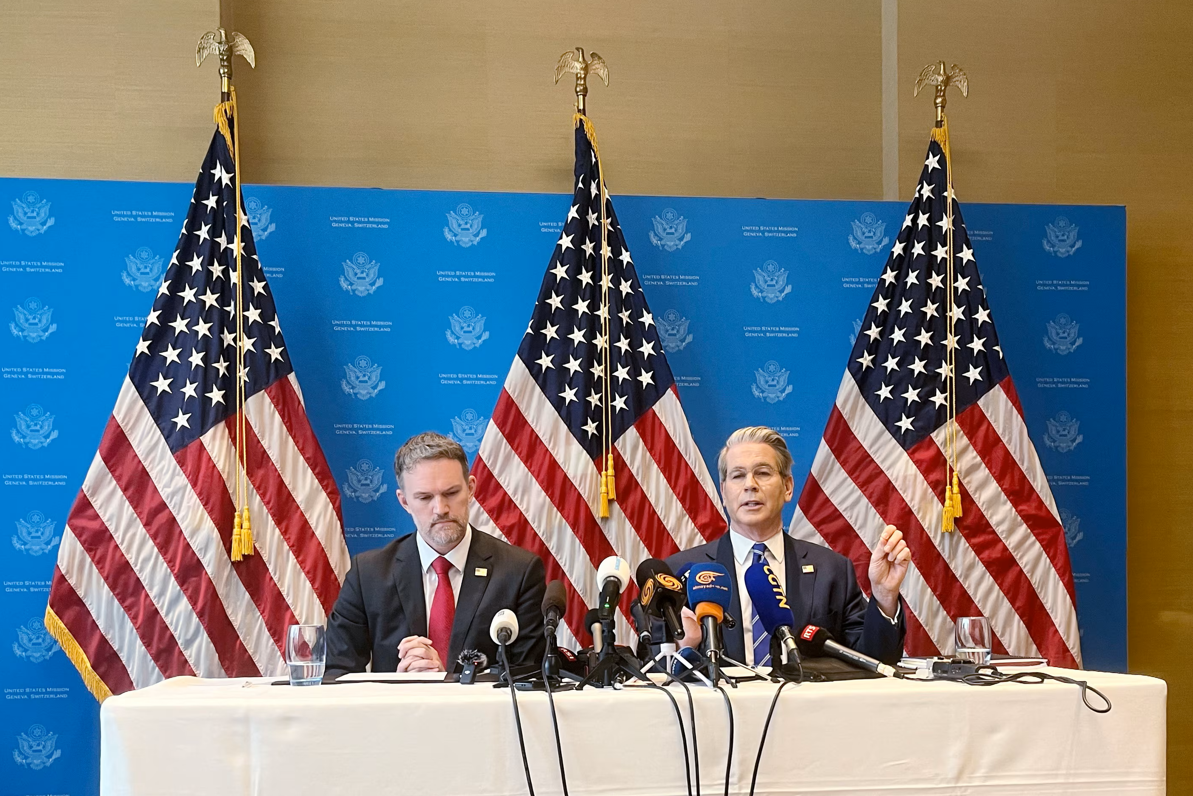
After the talks, U.S. Treasury Secretary Scott Bessent said, “Both countries represented their national interest very well… We both have an interest in balanced trade, the U.S. will continue moving towards that.”
Bessent was speaking alongside U.S. Trade Representative Jamieson Greer after the weekend talks in Switzerland in which both sides had hailed progress on narrowing differences.
“The consensus from both delegations this weekend is neither side wants a decoupling,” Bessent said. “And what had occurred with these very high tariffs … was the equivalent of an embargo, and neither side wants that. We do want trade.”
The Geneva meetings were the first face-to-face interactions between senior U.S. and Chinese economic officials since Trump returned to power and launched a global tariff blitz, imposing particularly hefty duties on China.
Bessent said the deal did not include sector-specific tariffs and that the U.S. would continue strategic rebalancing in areas including medicines, semiconductors and steel where it had identified supply chain vulnerabilities.
Since taking office in January, Trump had hiked the tariffs paid by U.S. importers for goods from China to 145%, in addition to those he imposed on many Chinese goods during his first term and the duties levied by the Biden administration.
China hit back by putting export curbs on some rare earth elements, vital for U.S. manufacturers of weapons and electronic consumer goods, and raising tariffs on U.S. goods to 125%.