Algeria Condemns Zionist Aggressions Against Iran at UN Security Council Meeting

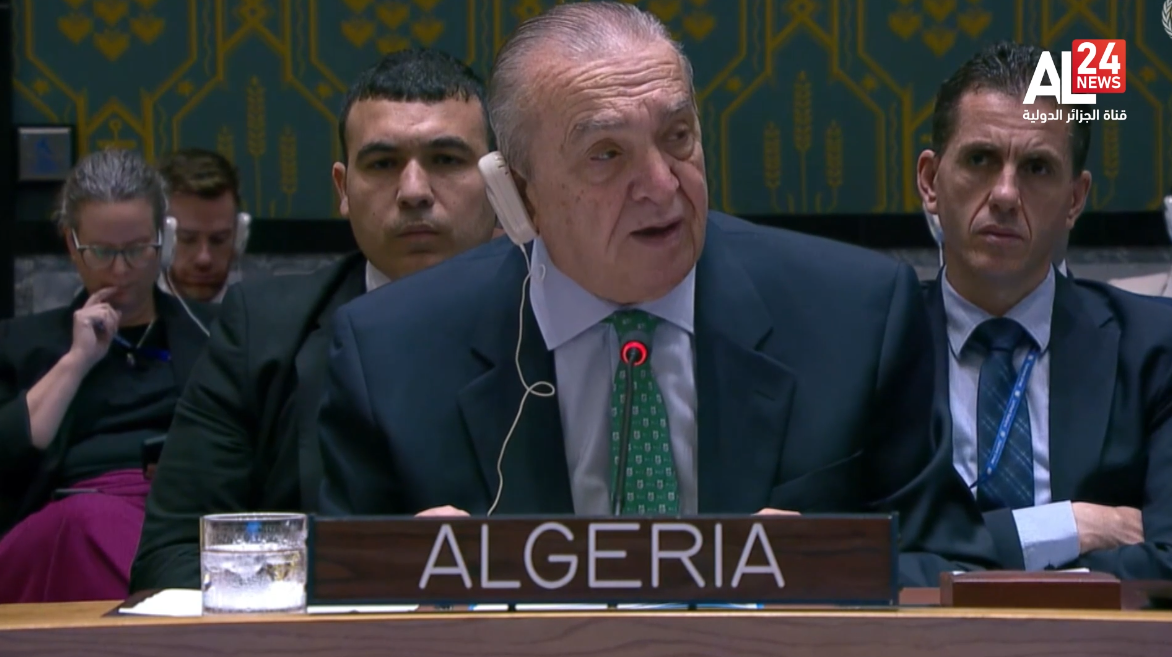
On Friday in New York, Algeria’s Permanent Representative to the United Nations, Mr. Amar Bendjama, stated that the aggressions by the Zionist entity against Iran are unjustified and represent a blatant violation of the UN Charter. The country warned that these attacks on facilities safeguarded by the International Atomic Energy Agency (IAEA) threaten the credibility of the entire nuclear non-proliferation regime.
During his address at a Security Council meeting focused on “Dangers Threatening International Peace and Security,” Mr. Bendjama declared, “The aggressions of the Zionist entity against Iran are unjustifiable and constitute a clear violation of the United Nations Charter,” highlighting that these actions have targeted nuclear facilities protected under IAEA safeguards.
He cautioned, “If these safeguards and the presence of international inspectors in Iran are insufficient to protect these facilities, then the credibility of the entire non-proliferation system is severely compromised.”
The Algerian diplomat further stated, “If those meant to uphold this system are unable or unwilling to condemn these violations, they must reconsider their role and true responsibilities.” He continued, “We must resist any attempt to justify what is fundamentally an act of aggression against a sovereign state, a member of the United Nations. Any misleading narrative in this context is unacceptable.”
In this regard, Mr. Bendjama referenced remarks made by IAEA Director General Rafael Grossi during an interview with CNN, noting, “We [the IAEA] had no evidence of systematic efforts to produce a nuclear weapon,” emphasizing that such statements “deserve our full attention.”
He underscored the necessity for all parties to “return to reason,” pointing out that negotiations between Iran and three European countries, as well as between Iran and the United States—facilitated by the Sultanate of Oman—”remain a constructive and viable option and a triumph of diplomacy.” He reminded attendees that “even in times of high tension, mediation and the principles of the UN Charter remain the only effective instruments at our disposal.”
Mr. Bendjama reaffirmed, “Algeria has always believed in the power of dialogue.” He emphasized that “Algeria cannot accept double standards regarding respect for international humanitarian law. Civilians and civilian infrastructure must be protected everywhere and at all times,” adding, “We have consistently warned against violations of international humanitarian law, particularly in Gaza, where regrettably, such violations have become the norm.”
He stated, “Those responsible for the collapse of the healthcare system in Gaza, the deaths of 1,580 medical personnel, 18,000 children, over 10,000 women, 225 journalists, and 467 humanitarian workers cannot credibly assert their commitment to international humanitarian law.”
The diplomat also stressed that “no measure can substitute for the responsibility that rests with the Security Council,” recalling Resolution 487 adopted in 1981 following the Zionist attack on the Osirak reactor in Iraq.
He remarked that this resolution “has never been implemented: the nuclear facilities of the Zionist entity have not been subjected to IAEA safeguards, Iraq has never received compensation, and the Council has not been informed of any follow-up measures. This underscores the grave consequences of a legacy marked by impunity and immunity.”
Mr. Bendjama concluded his speech by stating, “What we are witnessing today is not just an isolated act of aggression; it represents a significant challenge to the foundations of international law. The Security Council must fully embrace its mandate and address any actions that threaten international peace and security. Inaction cannot be an option.”