Algerian Agriculture Thrives in 2024 with Strategic Projects Enhancing Food Security

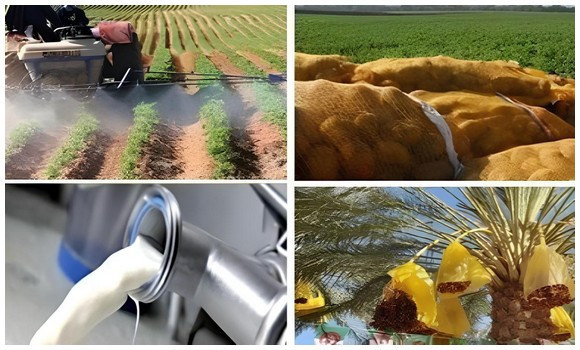
ALGIERS — The agricultural sector witnessed exceptional dynamic in 2024, thanks to the multiplication of initiatives and the launch of several strategic projects aimed at increasing national production, particularly in the cereal and dairy sectors, so as to bolster food security and improve the country’s self-sufficiency.
Under the guidance of the Algerian President, Abdelmadjid Tebboune, these nationwide initiatives and projects mirror the determination of public authorities to develop this critical sector that has successfully maintained agricultural product availability despite recent challenges.
Agriculture, generating $37 billion in value, stands as the second-highest GDP contributor behind hydrocarbons at 15%, maintaining its position as one of the economy’s key sectors and major employers. The State has invested substantial resources to bolster this sector, particularly through various incentive measures.
The measures include enhanced subsidies for essential commodities, with increased procurement prices for cereals and legumes from farmers, while fertilizer subsidies have been elevated to 50% of benchmark prices to offset international market increases. The power grid has also been expanded to reach tens of thousands of farming operations.
The State’s strategic investment in agriculture has enhanced the sector’s appeal, facilitating partnerships with international corporations, notably in the southern regions, where conditions are conducive to large-scale project development.
In this respect, the Ministry of Agriculture, Rural Development and Fisheries signed a framework agreement last July with the Italian company Bonifiche Ferraresi (BF) for the implementation of an integrated project for the production of cereals, legumes and pasta.
This project, conducted in partnership between BF and the Algerian state, represented by the National Investment Fund (FNI), covers an area of 36,000 hectares in Timimoun province.
The project scope includes cultivation of wheat, lentils, dry beans and chickpeas, complemented by pasta production facilities, storage silos and critical infrastructure development.
The 420-million-euro investment targets expansion of domestic grain and pulse production while bolstering non-hydrocarbon exports, specifically in pasta products. This is expected to generate over 6,700 jobs, with 1,600 permanent positions.
Another agreement was signed last April with Qatari company Baladna for an integrated dairy cattle farming and milk powder production project in the province of Adrar.
The expansive 117,000 hectares project consists of three hubs, each incorporating a grain and fodder production farm, a diary and beef cattle farm and a milk powder manufacturing plant.
These two projects add to other investments initiated by national operators as part of the state’s strategy to expand agricultural land, particularly in the southern provinces, for strategic crops such as durum wheat, yellow corn and oilseeds.
This strategy also aims to irrigate one million hectares and achieve self-sufficiency in three key crops: corn, barely and durum wheat.