World’s Largest Coral Discovered Near the Solomon Islands in the Pacific

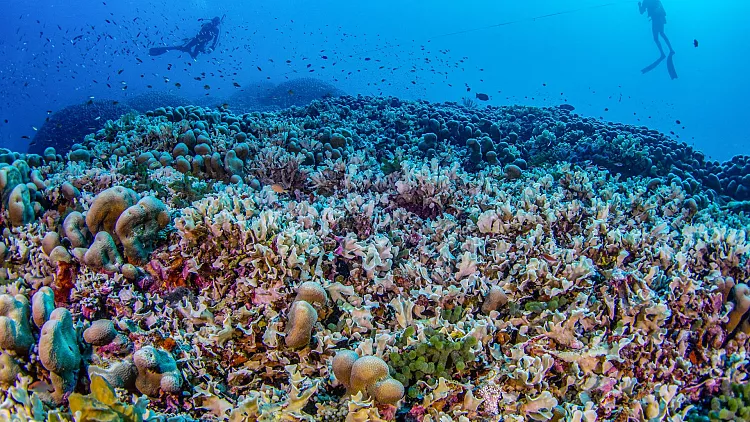
Scientists announced on Thursday the discovery of the world’s largest coral near the Solomon Islands in the Pacific, which measures three times larger than the previous record holder.
“Just when we think there is nothing left to discover on planet earth, we find a massive coral made of nearly a billion little polyps, pulsing with life and color,” National Geographic explorer Enric Sala, founder of the Pristine Seas project, said.
The coral was discovered in an area known as “Three Sisters,” located in the southeastern part of the Solomon Islands, by a National Geographic team participating in a scientific expedition in the region.
According to researchers, this unique structure has developed over approximately 300 years from a “complex network” of minute coral polyps. They clarified that it differs from a coral reef, which consists of numerous distinct colonies.
Measuring 34 meters wide and 32 meters long, the newly found coral in the Solomon Islands is three times larger than the previous record holder located in American Samoa, affectionately nicknamed “Big Momma.”
“Large adult coral colonies like this contribute significantly to the recovery of coral reef ecosystems due to their high reproductive potential,” remarked Eric Brown, coral scientist for the Pristine Seas expedition.
“While the nearby shallow reefs were degraded due to warmer seas, witnessing this large healthy coral oasis in slightly deeper waters is a beacon of hope.”
Right now, just 8.4 per cent of the earth’s ocean is protected to some degree.
“It is a natural monument that has seen the arrival of the first Europeans to these waters,” added San Félix, who first spotted the coral.
“Illustrious figures of humanity have coexisted with this colony: Newton, Darwin, Curie, Gandhi, Einstein… and it has survived them.”
“It now stores information on how to survive throughout the centuries. The genetic code of these simple polyps is an enormous encyclopedia that has written how to survive multiple climatic conditions, and until now, it does so in the face of ocean warming.”