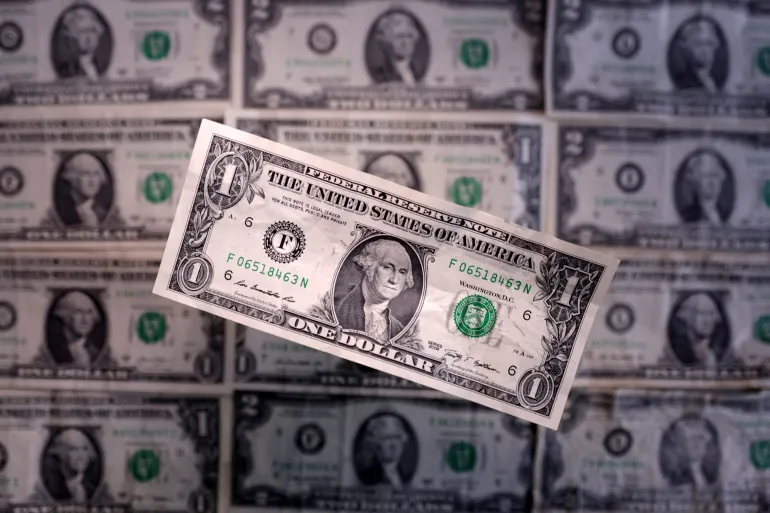
The share of the US dollar in global foreign exchange reserves is declining as countries seek to diversify amid policy uncertainties, according to the latest data from the International Monetary Fund (IMF).
Global reserves surged to $13 trillion in the third quarter of 2025. During this period, the US dollar accounted for 56.92% of global reserves, down from 58.51% in the first quarter and 57.08% in the second quarter. The dollar’s share has steadily fallen from 71.19% at the beginning of 1999.
Meanwhile, the euro’s share increased to 20.33% in the third quarter, up from 19.12% in the first quarter of 2025. The Japanese yen fluctuated, falling to 5.65% in the second quarter before rising to 5.82% in the third quarter. The Chinese yuan’s share slightly decreased to 1.93% in the third quarter, after peaking at 1.99% in the second quarter.
Despite the decline in global reserves, the US dollar remains dominant in financial transactions worldwide. Approximately 50.49% of global payments were made in dollars in December 2025, according to SWIFT data, while the euro accounted for 21.9%, the pound sterling 6.73%, the Canadian dollar 3.44%, the Japanese yen 3.42%, and the Chinese yuan 2.72%.
Experts attribute the dollar’s decline in reserves to diversification strategies by reserve managers, who are adding non-traditional currencies such as the Canadian and Australian dollars. Steven Kamin, senior fellow at the American Enterprise Institute, noted that countries like Switzerland have grown their reserves with a smaller share of the US dollar. Kamin added that while the dollar may lose some share, it is unlikely to be replaced as the dominant global currency in the foreseeable future.
Olu Sonola, head of US economic research at Fitch Ratings, said the decline reflects policy uncertainties over the past year, including tariff-induced risks, Greenland-related concerns, and potential fiscal challenges in Japan. He emphasized that the US dollar remains supported by deep credit and bond markets, which continue to reinforce its central role in the global monetary system.
While the global financial system may evolve toward a more multipolar structure, the US dollar is expected to remain the most important currency for the foreseeable future.