UN General Assembly Adopts Resolution Supporting Two-State Solution

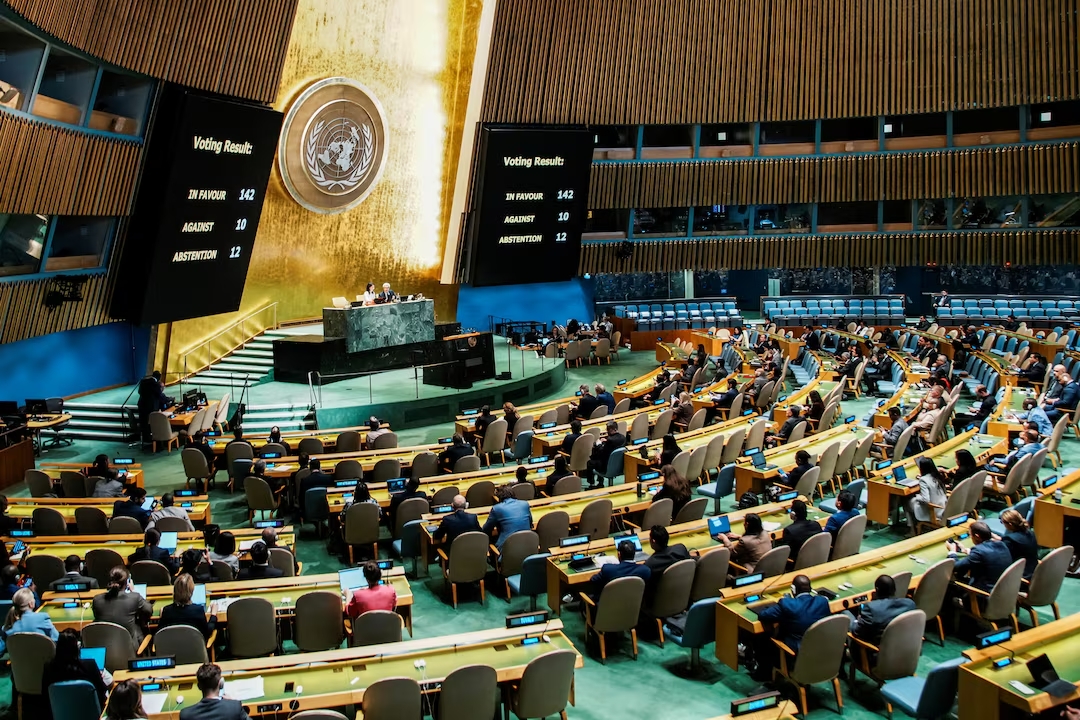
On Friday, the United Nations General Assembly voted to approve a resolution endorsing the “New York Declaration,” which aims to implement a two-state solution and establish an independent Palestinian state.
In this vote, 142 countries supported the resolution, while 10 opposed it and 12 abstained. The “New York Declaration” calls for an end to aggression against Gaza and advocates for a “just, peaceful, and sustainable resolution to the Palestinian conflict,” based on the genuine implementation of the two-state solution.
Looking ahead to a potential ceasefire, the declaration also discusses the deployment of a “temporary international stabilization mission” in Gaza, mandated by the UN Security Council, to protect the population, assist in building the capacities of the Palestinian state, and provide “security guarantees.”
In a statement released by its Ministry of Foreign Affairs, the State of Palestine praised the significant efforts made to transform the “New York Declaration” into an actionable plan accompanied by clear measures across political, economic, legal, and security domains. It urged the activation of all tools necessary to end the occupation.
It is important to note that the “New York Declaration,” adopted at the end of July following the UN High-Level Conference on the Peaceful Settlement of the Question of Palestine and the Implementation of the Two-State Solution, called for “collective practical measures” to halt Zionist aggression against Gaza, immediately lift restrictions, and open crossings throughout the Gaza Strip.
Conference participants urged the Zionist entity to publicly and unequivocally commit to a two-state solution, which includes the establishment of a sovereign Palestinian state, to immediately end settler violence, and to halt all settlement activities, land seizures, and annexations in the occupied Palestinian territories, including East Al-Quds.
The New York Declaration also emphasized the necessity of preserving the legal and historical status quo regarding Islamic and Christian holy sites in Al-Quds and committed to implementing restrictive measures against extremist settlers and individuals supporting settlements, in accordance with international law.