Tripartite Mechanism on Libya Worked Toward Inclusive Political Solution to Crisis, Says Attaf

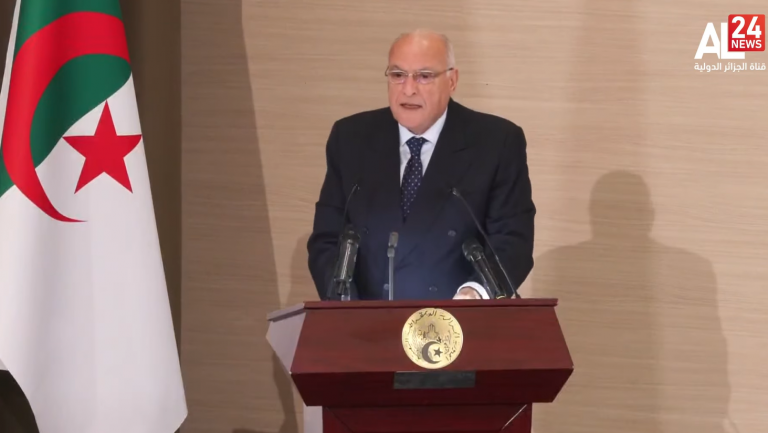
The Algerian Minister of State, Minister of Foreign Affairs, National Community Abroad and African Affairs, Ahmed Attaf, affirmed on Tuesday that the tripartite mechanism recently hosted by Algeria on Libya has worked to find a political solution to the crisis in that country, involving all stakeholders.
Speaking at a press conference at the Algerian ministry headquarters, Attaf said the three countries have worked in coordination and now speak with one voice to establish communication channels with Libyan parties, examining closely how neighboring countries can help resolve the Libyan crisis.
The tripartite mechanism has also been building relations with the different parties to launch a political process “that could help develop a political settlement to the crisis.” Regarding the congratulatory message sent by Niger’s President Abdourahamane Tiani to the President of the Republic, Abdelmadjid Tebboune, for the November Revolution commemoration, in which he reaffirmed “his commitment to strengthening consultation, cooperation and the bonds of friendship and brotherhood between the two countries,” Attaf said “the message was notable for its content — it was not just a routine diplomatic formality. Its tone reflected a genuine desire to improve bilateral relations. That is our interpretation of the message.” He said that “there is no problem between us and Niger, quite the opposite. What happened is that Niger and Burkina Faso sided with Mali when it withdrew from the Algiers Agreement and became engaged in a verbal conflict with Algeria. As a result, they were the ones who sent bilateral relations into a downward spiral by withdrawing their ambassadors.” Attaf further noted Algeria’s willingness to “restore relations to how they were before.” “We have no issues with these two brotherly countries,” he added.
Regarding pressure to change the route of the Trans-Saharan Gas Pipeline (TSGP), launched by Algeria to transport natural gas from Nigeria to Europe via Niger and Algeria, Attaf noted that “the project has advanced in both its Algerian and Nigerian segments. A substantial portion of the pipeline has been completed in both countries, with only the Niger section remaining.” He continued, “studies have been conducted on the pipeline’s cost and construction timeline,” which underscore it is the best route for transporting natural gas to Europe.
On the possibility of reviving the political process in Sudan, the minister said that “the involvement of external parties has become a barrier to any political approach to resolving the crisis in that country,” adding that “as a Security Council member, we understand that any step to restart a peace process in Sudan cannot succeed given the complex situation on the ground.” Responding to a question about signs of a potential thaw in Algeria-France relations, Attaf stressed that “contacts between the two sides, Algeria and France, had been reestablished before the decision made by President Tebboune” — referring to his positive response to German President Frank-Walter Steinmeier’s request to grant a pardon to Boualem Sansal.
In this respect, he urged people “not to give this individual more attention than he deserves,” stressing that “Algeria-France relations are far more important and should not be swayed by certain well-known circles in France that have turned him into a standard-bearer of hatred and their settling of scores with Algeria.”