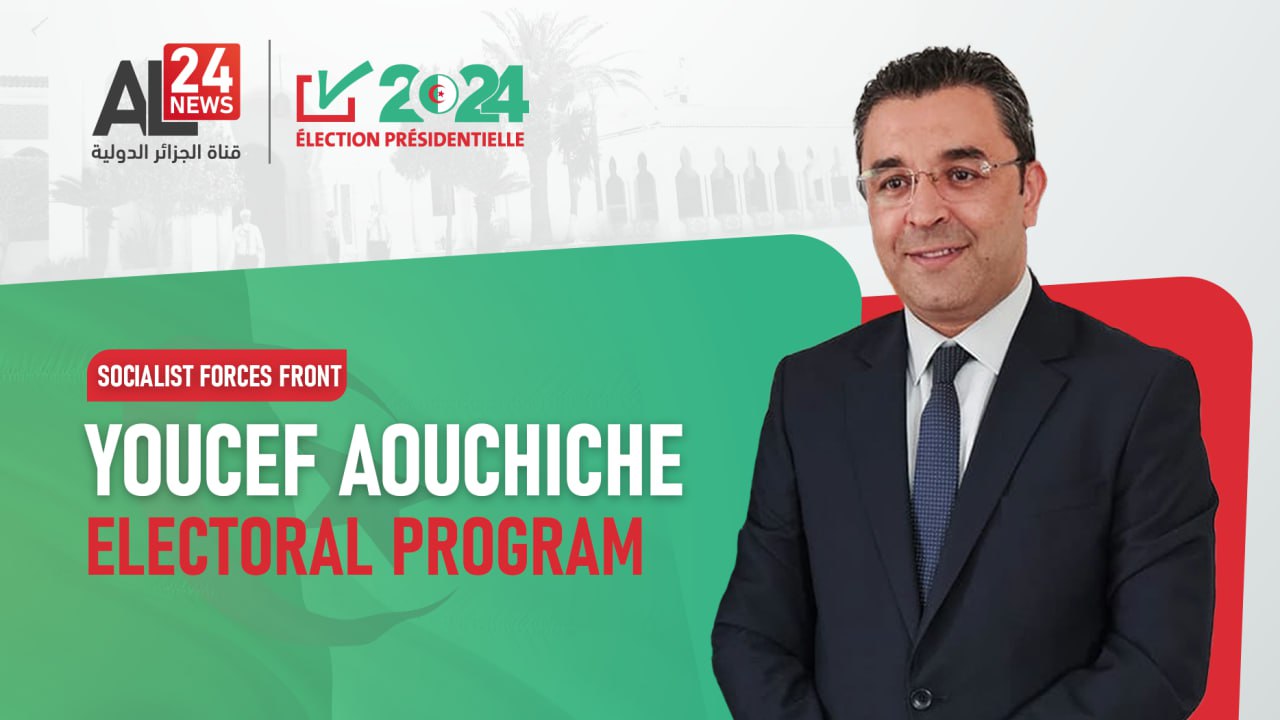
The Algerian Presidential Election: Key Points of Candidate Youcef Aouchiche’s Program
The Algerian presidential candidate Youcef Aouchiche has presented his electoral program titled "Vision," which covers key areas including politics, economy, social issues, and foreign affairs.

Judicial Reforms and Expanded Parliamentary Powers
Youcef Aouchiche believes his electoral program aims to “raise the bar high” in establishing a rule of law, freedoms, and democracy through profound and radical reforms in political and institutional life. He proposes adopting a semi-presidential system with a parliamentary focus to ensure a real balance of powers. Aouchiche argues that the coherence, stability, and permanence of institutions are more important than the strength and dominance of individual authorities. He is committed to expanding parliamentary powers and holding general elections in the first half of 2025.
As the candidate from the Algerian Front of Socialist Forces, Aouchiche promises to “ensure judicial independence” by reforming the Constitutional Court and the Supreme Council of the Judiciary, restoring the balance of justice, and ensuring equality before the law to address injustice and disrespect the law. He also aims at “strengthening and rehabilitating parliamentary oversight tools and the Court of Auditors by granting it broader powers, especially in terms of notification authority.”
Aouchiche’s program includes a “radical” vision for reforming local communities by “establishing decentralization and participatory democracy” and granting greater powers and autonomy to elected local authorities. Regarding state structure and organization, he pledges to create new administrative economic poles, establish new provinces and municipalities, and eliminate the district level from the national administrative division.
Review of Wages and Allowances and Establishment of a “Social State”
Regarding social issues, Youcef Aouchiche’s electoral program, which is anchored in the legacy of the “social state,” aims to reassess purchasing power. This includes raising the guaranteed minimum wage to 40,000 Algerian dinars, eliminating income tax for wages below 50,000 dinars, and capping food prices.
Aouchiche pledges to create a minimum income for everyone equal to 50% of the guaranteed minimum wage, re-evaluate family allowances to 3,000 dinars per child, and activate the right to early retirement before the end of the year. He also commits to “empowering the shrinking middle class, where the rich are getting richer and the poor are getting poorer.”
Additionally, Aouchiche’s program proposes capping the cost of medical examinations at private facilities and including medical examination expenses in the “health card” reimbursements. It also includes reviewing the health map and restoring public health facilities through effective measures.
Transition from a “Rentier State” and Creation of Integrated Economic Poles
On the economic front, Aouchiche’s program outlines a comprehensive vision for boosting the sector and permanently moving away from a “rentier” system. This involves diversifying the economy, improving the business climate, increasing exports, modernizing the banking and financial system, and combating the informal market. The program aims to create interconnected and integrated economic poles based on regional specifics to support national economic development and enable citizens to play a key role in the development process.
In agriculture, the program proposes “revolutionary” measures related to food sovereignty, agricultural planning, livestock production, land management, and the establishment of a National Food Security Agency. It includes a new industrial policy, starting with organizing general sessions on industrial transformation and transition, implementing a national strategy for sector development, and taking concrete steps to rehabilitate the transport sector. The program also suggests creating a National Food Security Agency and focusing on renewing the national strategic stock of widely consumed food items, medicines, fuel, energy, and others.
Increasing Sector Budgets and Removing Schools from “Ideological Conflicts”
The program includes measures to benefit the education, higher education, and health sectors, with a commitment to increase their budgets by at least 50% for each sector, especially for education. Candidate Aouchiche pledges to remove schools from what he describes as “ideological conflicts,” and to transform them into places of learning that develop intellectual and cognitive capacities. He also proposes converting the National University Services Office into a public economic institution, enhancing its development and ensuring its independence. Additionally, he plans to increase the university student stipend to 20,000 Algerian dinars per month as part of the guaranteed minimum income, and to integrate all holders of “Master’s” and “Doctorate” degrees into the higher education sector without restrictions.
Regarding culture and identity, Aouchiche commits to passing an organic law to establish “official recognition of the Amazigh language” as a component of national identity. He plans to set up an Amazigh language academy, make Amazigh language education a mandatory subject, create a National Agency for the Protection and Promotion of Algerian Historical Heritage, and develop a cultural city to advance the arts and cinema.
“Offensive Diplomacy” and Enhancing Algeria’s Role in Mediation
Regarding foreign affairs, Aouchiche’s program advocates for adopting an “offensive” diplomatic policy and playing a greater role as a mediator in resolving regional and international conflicts. It includes strengthening and supporting Algeria’s spheres of influence in Africa, as well as re-evaluating Algeria’s relationships with all its partners based on national interests, reciprocity, and mutual respect. The program also emphasizes reinforcing relations with new African partners, continuing support for the Palestinian and Sahrawi causes, and promoting free trade zones within Africa to facilitate intra-African trade, while resuming negotiations with the European Union.
Aouchiche pledges to establish a strong sovereign ministry for planning and foresight, aiming to develop a long-term vision for the country’s growth through 2050. He also proposes the creation of a National Observatory for Strategic Vigilance.