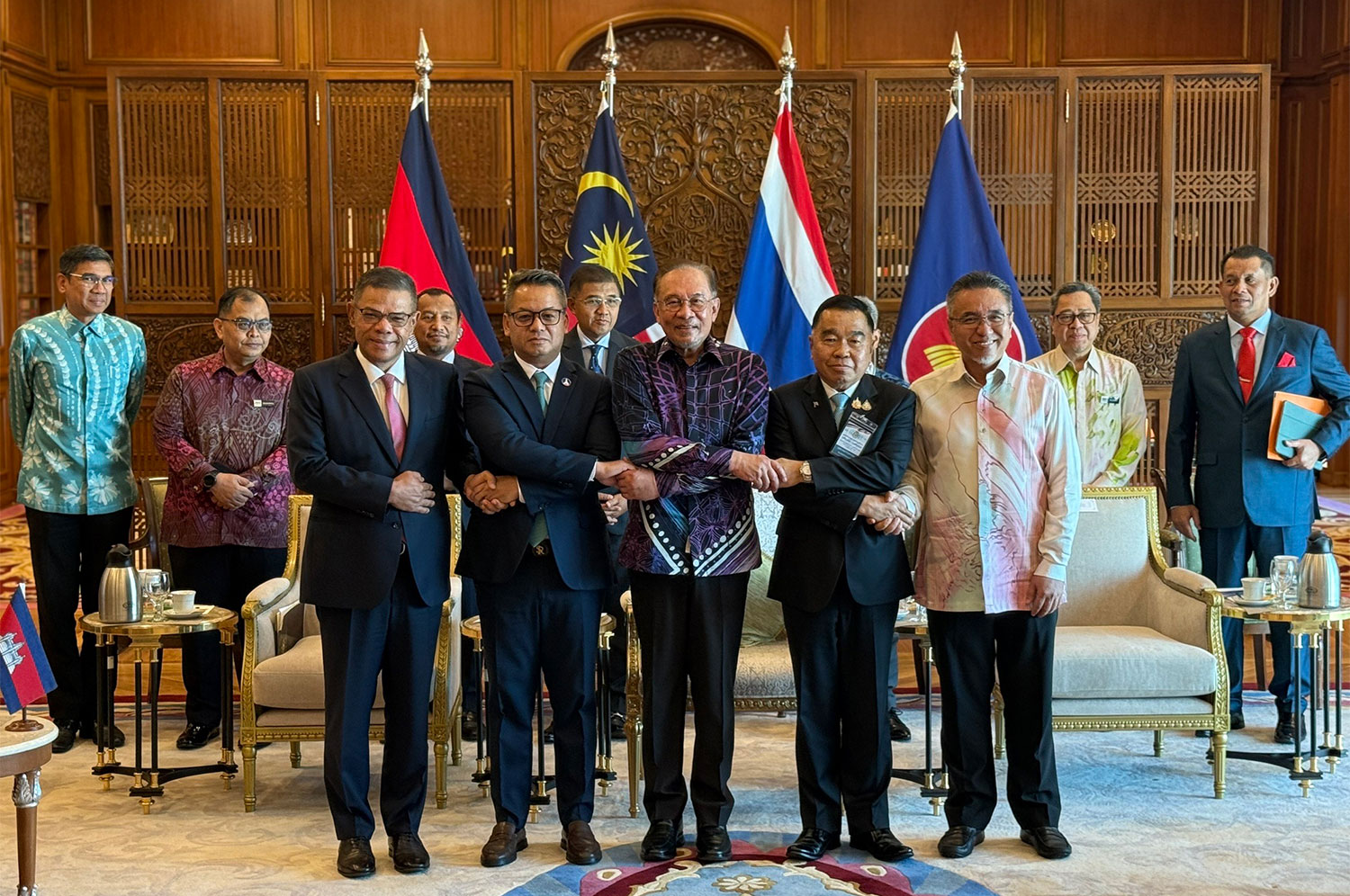
KUALA LUMPUR – Thailand and Cambodia agreed Thursday to a 13-point ceasefire implementation plan aimed at easing tensions along their disputed border, following five days of armed clashes last month that resulted in dozens of deaths and injuries.
The agreement was reached during a General Border Committee meeting held in Kuala Lumpur, Malaysia’s capital, and co-chaired by Cambodian Defense Chief Gen. Tea Seiha and Thai Defense Chief Gen. Nattaphon Narkphanit. According to a statement from the Cambodian Information Ministry, the two sides committed to maintaining peace along the border, with Malaysia acting as the official mediator.
The Thai Enquirer reported that the ceasefire plan aims to “ensure peaceful coexistence between border communities.” Earlier in the day, Malaysian Prime Minister Anwar Ibrahim received the two defense ministers ahead of the bilateral meeting. Anwar said both visiting defense chiefs had “given their commitment to observe a full ceasefire” and expressed a joint desire for Malaysia to continue facilitating peace talks “without involving others within and outside ASEAN.”
The ceasefire agreement follows a trilateral meeting on July 28, during which both countries agreed to an unconditional ceasefire. Clashes had erupted along the contested border between Cambodia’s Preah Vihear province and Thailand’s Ubon Ratchathani province, reigniting tensions that had remained dormant for years. Fighting since May 28 has left numerous casualties, including civilians.
The border committee talks, which began at the officials’ level on Monday, concluded Thursday with the participation of the defense chiefs. Officials from Malaysia, the United States, and China were present as observers.
Anwar noted that the meeting resulted in a key consensus to uphold the ceasefire and sustain dialogue. “I appreciate the trust placed in Malaysia to continue facilitating the peace process,” he said. The Malaysian Defense Forces chief, Gen. Tan Sri Mohd Nizam Jaffar, also participated in the efforts.
Among the agreed points are: full adherence to the ceasefire, no further military aggression, no repositioning or increase in troop presence, avoidance of provocations, and a strong commitment to protecting civilians and civilian infrastructure.
The leaders also discussed the potential deployment of an ASEAN Observer Team to help monitor the situation, support humanitarian efforts, and coordinate medical assistance along the border. Anwar, who currently chairs the ASEAN bloc, reaffirmed Malaysia’s commitment to peace, emphasizing that “lasting peace is only possible through dialogue, mutual respect, and genuine friendship.”