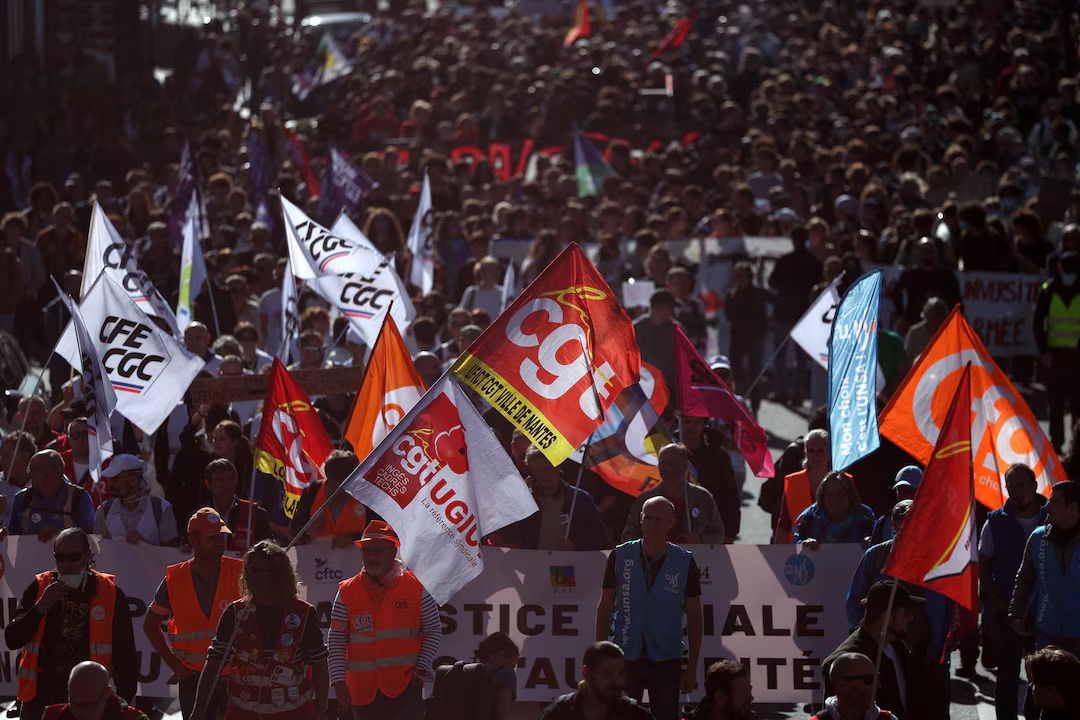
Tens of thousands of demonstrators marched through several French cities on Thursday, answering the call of trade unions demanding measures against drastic spending cuts planned in next year’s budget.
The government of newly appointed Prime Minister Sébastien Lecornu, who is still working on forming his cabinet, faces mounting pressure to stabilize the country’s finances as France teeters on the brink of a financial crisis due to excessive debt. But union leaders, including those from the CGT and France’s largest union, the CFDT, are pushing for increased public spending, higher taxes on the wealthy, and the abandonment of a reform to state pensions. “First, what we want to know is who will be in the government … And then we want to know what the budget will be, and if there are setbacks in the budget, obviously we will not let it pass,” said CGT Secretary General Sophie Binet on BFM TV.
Students with flares blocked the entrance of a Paris high school as protests began, with police deployed on-site, according to Reuters. More demonstrations were planned in Paris and other cities, including Dijon, Metz, Poitiers, and Montpellier. French authorities said about 76,000 police officers would be deployed, 5,000 of them in the Paris region. By midday, officials counted 85,000 protesters nationwide outside Paris, according to Le Monde. The Paris march, set to begin from Place d’Italie at 2 p.m., had yet to be included in the figures.
Blockades and work stoppages disrupted several French universities. In Lille, a campus was shut down after about 60 students and unionized staff intervened, according to Solidaires Étudiant·e·s. In Montpellier, police moved in as early as 6 a.m. at Paul Valéry University to prevent a blockade, the Hérault prefecture said. The French government already faced strikes and protests in September, when hundreds of thousands—including teachers, train drivers, pharmacists, and hospital staff—demonstrated against the 2026 budget plan, while high school students blocked dozens of schools for hours.
Last year, France’s budget deficit nearly doubled the EU ceiling of 3%. Lecornu now faces an uphill battle to win parliamentary approval for the 2026 budget. While parties broadly agree on the need to reduce the deficit, which reached 5.8% of GDP in 2024, they remain deeply divided on how to achieve it. Lecornu’s predecessor, François Bayrou, was ousted by parliament on September 8 over his proposal to cut spending by €44 billion.