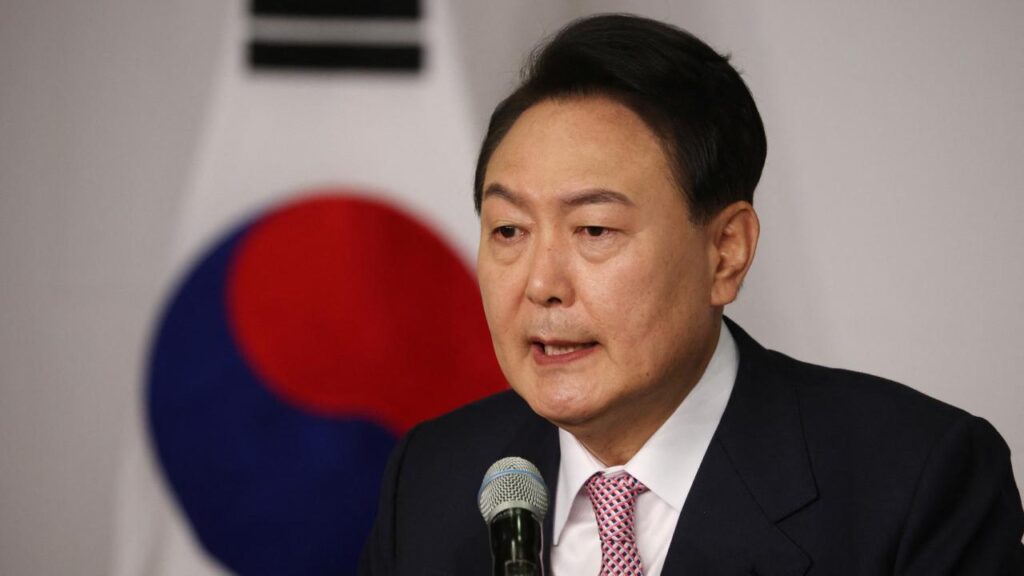
In a significant escalation of the ongoing investigation into President Yoon Suk Yeol’s declaration of martial law, South Korean police executed a raid on the president’s office on Wednesday. The operation led to the arrest of several high-ranking officials, including former Defense Minister Kim Yong-hyun.
The Special Investigation Team (SIT) announced that the raid targeted multiple locations, including the presidential office, the National Police Agency, the Seoul Metropolitan Police Agency, and the National Assembly Security Service. This decisive action comes as the probe into President Yoon’s decision to impose martial law gains momentum.
President Yoon is currently under a travel ban as part of an “insurrection” investigation following his brief suspension of civilian rule on December 3. The martial law declaration, intended to protect South Korea from perceived threats posed by North Korea and to eliminate anti-state elements, has sparked widespread controversy and significant political turmoil.
Former Defense Minister Kim Yong-hyun was formally arrested late Tuesday on charges of “engaging in critical duties during an insurrection” and “abuse of authority to obstruct the exercise of rights.” Reports from Yonhap News Agency indicated that Kim attempted suicide shortly before his arrest. A spokesperson for the Seoul Central District Court confirmed that Kim was detained amid fears of evidence tampering.
In addition to Kim, other officials apprehended include Cho Ji-ho, Commissioner General of the Korean National Police Agency, and Kim Bong-sik, Head of the Seoul Metropolitan Police Agency. These arrests are part of a broader crackdown on individuals implicated in the failed attempt to reinforce martial law, which saw troops and helicopters deployed to the National Assembly in an unsuccessful bid to prevent lawmakers from voting against Yoon’s decree.
North Korean state media condemned the developments, labeling the incident as “chaos” instigated by what it described as President Yoon’s “fascist dictatorship.” The commentary accused Yoon of using martial law as a tool to undermine South Korean democracy and exacerbate tensions between the two Koreas.
Amidst the political upheaval, President Yoon faces dwindling public support, with recent polls indicating record-low approval ratings. Massive protests have persisted since his impeachment attempt, reflecting widespread dissatisfaction with his leadership and policies.
Within Yoon’s People Power Party (PPP), a special task force proposed a plan for the president to resign by February or March, followed by new elections in April or May. However, this proposal has yet to receive full party endorsement and may not prevent further impeachment efforts by the opposition.
The current motion for impeachment requires only eight members of the PPP to secure the necessary two-thirds majority. Last week, PPP lawmakers Ahn Cheol-soo and Kim Yea-ji supported the motion, with two additional members indicating their intention to back it in the upcoming vote.
As the investigation continues, the political landscape in South Korea remains highly volatile, with significant implications for the nation’s governance and its fragile relations with North Korea.