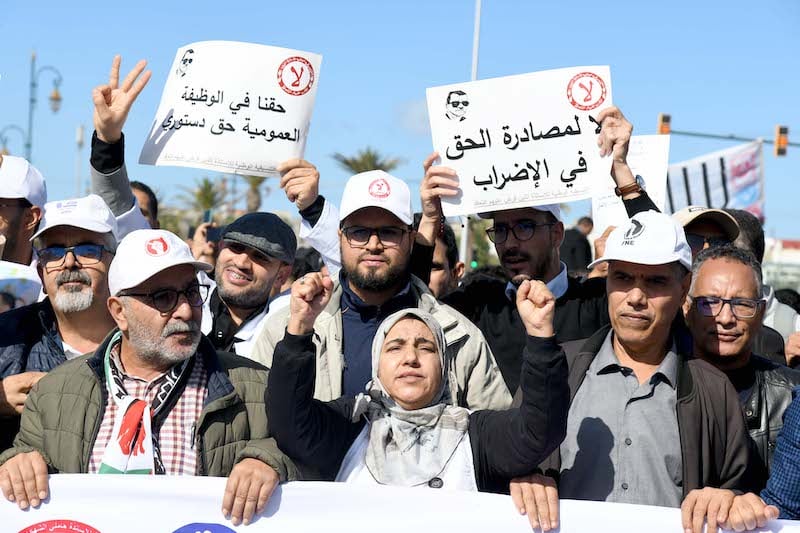
Moroccan trade unions continue to oppose the draft law regulating the right to strike, urging the government to withdraw it from Parliament and reintroduce it for social dialogue discussions.
The Democratic Confederation of Labor (CDT) has sent formal letters to parliamentary group leaders, stressing their responsibility in examining the draft law and drawing attention to its “flaws.” The union is pushing for lawmakers to pressure the government to return the proposal to the negotiation table.
In its message, the CDT argued that the draft law “violates key principles and recommendations of the International Labor Organization (ILO),” and fails to respect the spirit of international agreements on freedom of association and the protection of union rights, including ILO conventions that Morocco has yet to ratify. The union emphasized that these conventions, despite not being ratified, are considered binding as fundamental international standards.
The CDT expressed concerns that the draft “contradicts the right to strike as a constitutional guarantee, a historically legitimate practice available to all citizens, and a crucial responsibility of unions.”
The union also criticized the draft for lacking a preamble that clearly protects the constitutional right to strike, and for relying on vague and incomplete definitions. It accused the government of using language that aims to limit or suppress strikes, weaken union activities, and create legal ambiguities open to interpretation.
According to the CDT, the draft restricts the right to strike to public and private sector employees, excluding significant groups such as professionals, students, and independent workers—contrary to Article 29 of the Moroccan Constitution. The draft law imposes extensive limitations on the right to strike, reducing its scope and effectiveness, while banning many forms of strikes either explicitly or implicitly.
Moreover, the union criticized the draft for creating a complicated and restrictive process to announce a strike, making it nearly impossible for workers to stage a legal strike. It also noted that the law introduces intimidation tactics by threatening striking workers with severe financial and criminal penalties.
The CDT further claimed that the draft law disproportionately favors employers, granting them wide administrative, executive, and disciplinary authority within workplaces. It also broadens the state’s power to intervene in strikes, allowing for the suspension of strikes in essential service sectors.
Among the “flaws” highlighted by the union, the draft law extends strike prohibitions to several categories and sectors without justification. It also bans workers from occupying workplaces during strike actions.
The CDT informed parliamentary leaders that no agreement had been reached with the government on the draft law, accusing the government of failing to honor commitments made in previous social agreements. This, the union argued, undermines the government’s stated goals of promoting a “social state” and discredits its calls for meaningful social dialogue. Additionally, the government ignored the input of Morocco’s Economic, Social, and Environmental Council and the National Human Rights Council.
The CDT concluded by criticizing the government’s unilateral approach to the issue, which it claimed weakens social dialogue as a platform for resolving social issues. The union called for a return to the negotiation approach that led to the adoption of the Moroccan labor code, a law shaped by consensus among all stakeholders and passed unanimously by Parliament.
The CDT reiterated that a return to social dialogue is essential to ensuring the draft strike law respects international conventions and protects the constitutional rights of Moroccan workers. The union emphasized that social dialogue is a critical platform for achieving balanced and fair labor laws, as demonstrated by the process that resulted in Morocco’s labor code.
According to the union, the current draft law undermines this approach and risks eroding workers’ rights by favoring employers and limiting the scope of legal strikes. They warned that if the law were to pass in its current form, it would not only weaken union activities but also diminish the role of workers in advocating for their rights.
In closing, the CDT called on lawmakers to recognize the importance of ensuring any regulation of the right to strike aligns with Morocco’s commitments to international labor standards. They urged parliamentary groups to act responsibly and pressure the government to reengage in meaningful negotiations with unions to amend the draft law and reach a consensus that respects the rights of all workers.