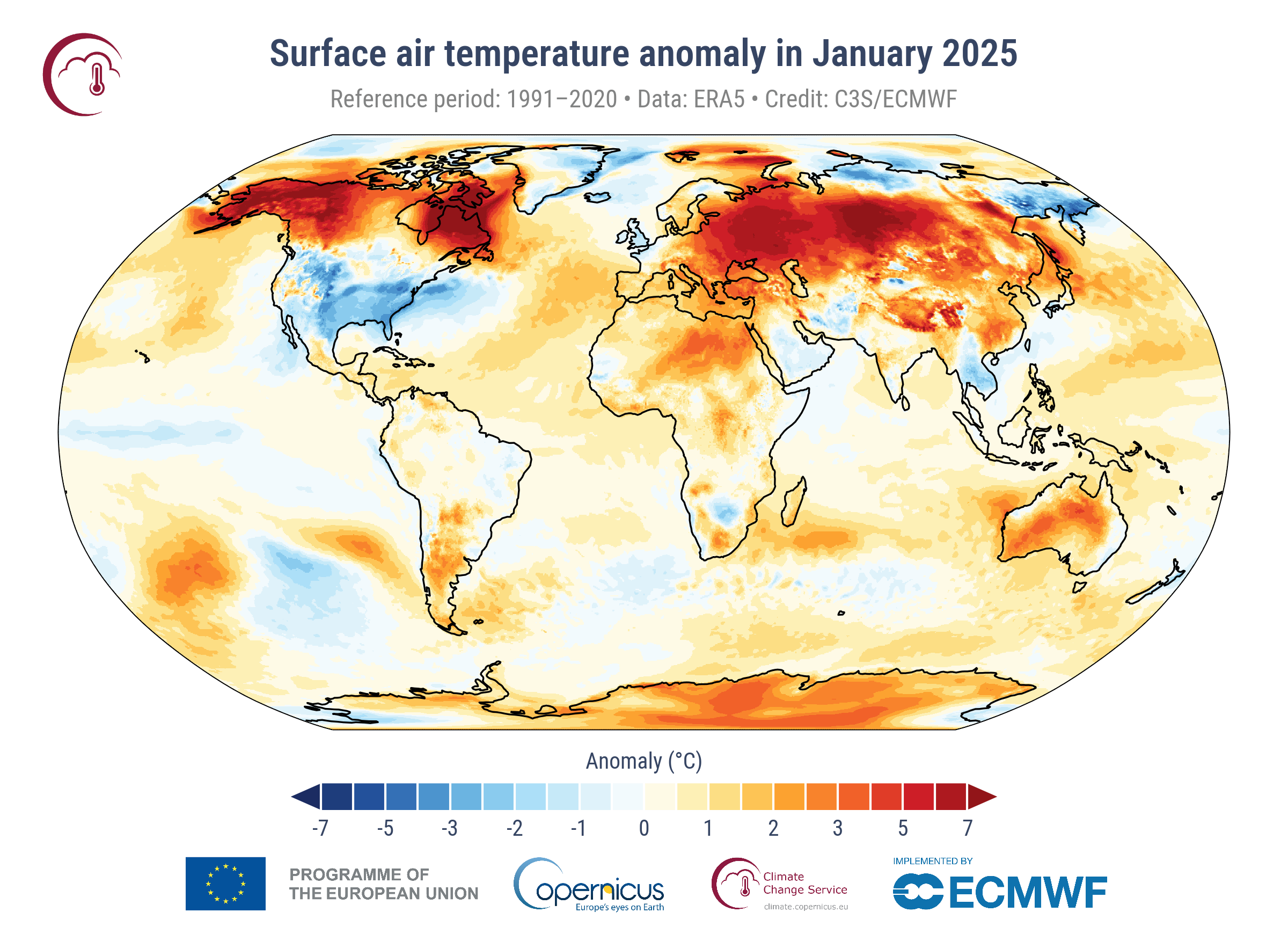
PARIS, February 6, 2025 – January 2025 has been identified as the hottest January on record globally, according to an announcement from the European observatory Copernicus. This new benchmark surpasses last year’s high, even following the conclusion of the El Niño phenomenon, which intensified climate warming during 2023-2024.
“January 2025 is another surprising month, continuing the record temperatures observed throughout the last two years, despite the development of La Niña conditions in the tropical Pacific and their temporary cooling effect on global temperatures. Copernicus will continue to closely monitor ocean temperatures and their influence on our evolving climate throughout 2025.”
With an average temperature of 13.23°C reported by Copernicus, “January 2025 exceeded pre-industrial levels by 1.75°C,” referring to the period before human activities significantly altered the climate through extensive use of fossil fuels such as coal, oil, and natural gas.
Consequently, January 2025 marks “the 18th month in the last nineteen months for which the global-average surface air temperature was more than 1.5°C above the pre-industrial level,” noted the observatory.
This figure is considerably above the +1.5°C threshold, which corresponds with the most ambitious target of the 2015 Paris Agreement aimed at keeping global warming well below 2°C while striving to limit it to 1.5°C.
However, this agreement concerns long-term trends: such an average warming must persist for at least 20 years for the limit to be considered breached. By this measure, current climate warming stands at approximately 1.3°C. The IPCC estimates that the 1.5°C threshold will likely be reached between 2030 and 2035, regardless of future greenhouse gas emissions from humanity, which are currently near their peak but not yet declining.
Global temperatures are profoundly influenced by those at the ocean’s surface, which acts as a primary climate regulator covering over 70% of the planet. Notably, sea surface temperatures have remained at unprecedented levels since April 2023.
For ocean surfaces, January 2025 ranks as the second hottest month, following the absolute record set in January 2024. However, Copernicus notes signs “of a slowing or stalling of the move towards La Niña conditions,” indicating a diminished cooling effect on global temperatures in 2025.