IAEA Calls Emergency Meeting After U.S. Strikes Major Iranian Nuclear Sites

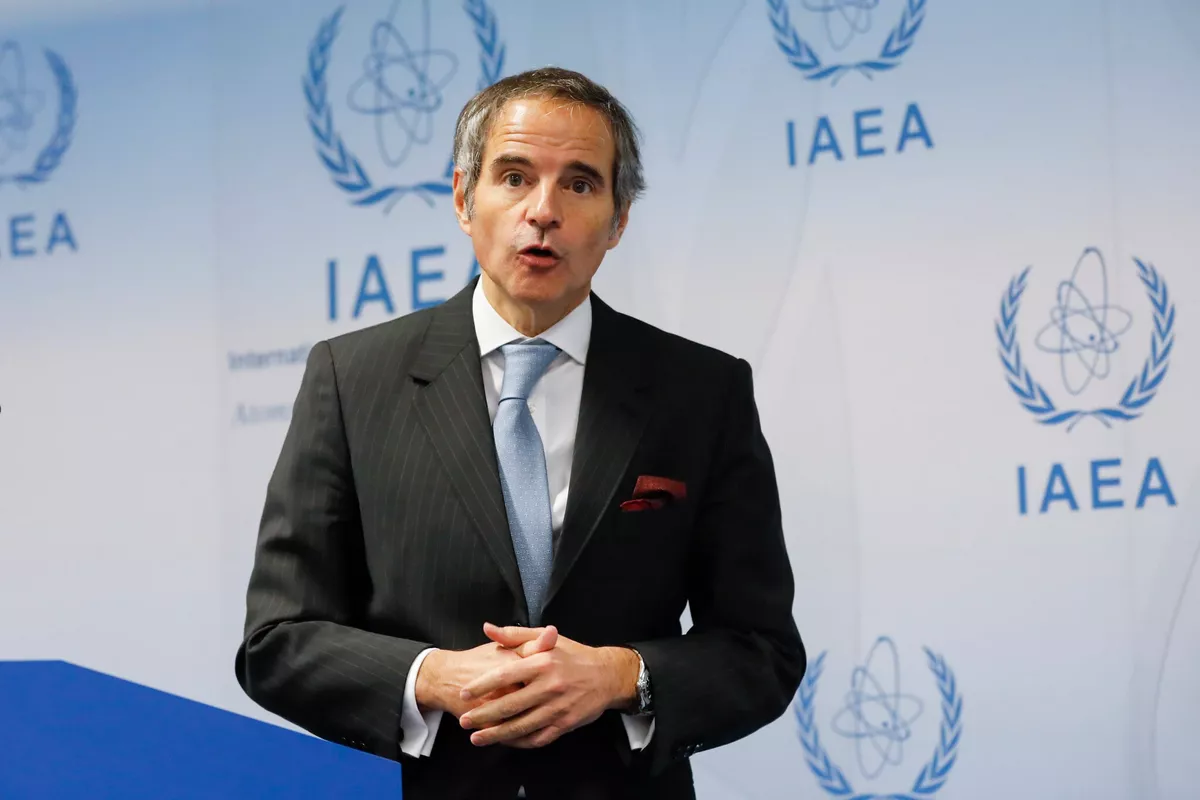
U.N. nuclear watchdog chief Rafael Grossi said on Sunday he was calling an emergency meeting of his agency’s 35-nation Board of Governors after the United States carried out military strikes on Iranian nuclear facilities.
“In light of the urgent situation in Iran, I am convening an emergency meeting of the (International Atomic Energy Agency) Board of Governors for tomorrow,” IAEA chief Grossi said on X.
Meanwhile, the agency said there had been no increase in off-site radiation levels reported following U.S. strikes on Iran’s three nuclear sites, including the Fordow site.
An Iranian official, cited by Tasnim news agency, confirmed part of the Fordow site was attacked by “enemy airstrikes”. However, Mohammad Manan Raisi, a lawmaker for Qom, near Fordow, told the semi-official Fars news agency the facility had not been seriously damaged.
Hassan Abedini, deputy political head of Iran’s state broadcaster, said Iran had evacuated the three sites some time ago.
“The enriched uranium reserves had been transferred from the nuclear centres and there are no materials left there that, if targeted, would cause radiation and be harmful to our compatriots,” he told the channel.
Trump told Fox News’ Sean Hannity show that six “bunker-buster” bombs were dropped on the deep-underground Fordow facility, while 30 Tomahawk missiles were fired against other nuclear sites. U.S. B-2 bombers were involved in the strikes, a U.S. official told Reuters, speaking on condition of anonymity.
The Atomic Energy Organization of Iran (AEOI) said in a statement that the three sites came under a “brutal assault,” that “violates international law,” particularly the Nuclear Non-Proliferation Treaty (NPT), of which Iran is a signatory.
The agency said the “unlawful action” was carried out because of the “indifference” or “complicity” of the International Atomic Energy Agency (IAEA).
Iran registered a complaint Sunday against Rafael Grossi, the head of the UN nuclear agency, accusing him of “indecision” on Israeli attacks on nuclear sites in the past week.
In parallel, Parliament Foreign Policy Committee Head Abbas Golroo said on X that Iran has the legal right to withdraw from the nuclear Non-Proliferation Treaty (NPT) based on its Article 10, which states that an NPT member has “the right to withdraw from the Treaty if it decides that extraordinary events have jeopardized the supreme interests of its country.”
Fordow in Focus
Fordow is Iran’s second nuclear enrichment facility after Natanz, its main facility, which already has been targeted by Israeli airstrikes. The IAEA says it believes those strikes have had “direct impacts” on the facility’s underground centrifuge halls.
Fordow is smaller than Natanz, and is built into the side of a mountain near the city of Qom, about 60 miles (95 kilometres) southwest of Tehran. Construction is believed to have started around 2006, and it became first operational in 2009 — the same year Tehran publicly acknowledged its existence.
In addition to being an estimated 80 metres (260 feet) under rock and soil, the site is reportedly protected by Iranian and Russian surface-to-air missile systems. Those air defences, however, likely have already been struck in the Israeli campaign, which claims to have knocked out most of Iran’s air defences.
Bunker-Buster Bomb Explained
“Bunker buster” is a broad term used to describe bombs that are designed to penetrate deep below the surface before exploding. In this case, it refers to the latest GBU-57 A/B Massive Ordnance Penetrator bomb in the American arsenal. The roughly 30,000-pound (13,600 kilogram) precision-guided bomb is designed to attack deeply buried and hardened bunkers and tunnels, according to the U.S. Air Force.
It’s believed to be able to penetrate about 200 feet (61 meters) below the surface before exploding, and the bombs can be dropped one after another, effectively drilling deeper and deeper with each successive blast. It was not immediately known how many were used in the Sunday morning strike.
The U.S. B-2 costs about $2.1 billion each, making it the most expensive military aircraft ever built. Made by Northrop Grumman NOC.N, the bomber, with its cutting-edge stealth technology, began its production run in the late 1980s but was curbed by the fall of the Soviet Union. Only 21 were made after the Pentagon’s planned acquisition program was truncated.