Ghali: UN-AU Settlement Plan is the Sole Framework for Decolonizing Western Sahara

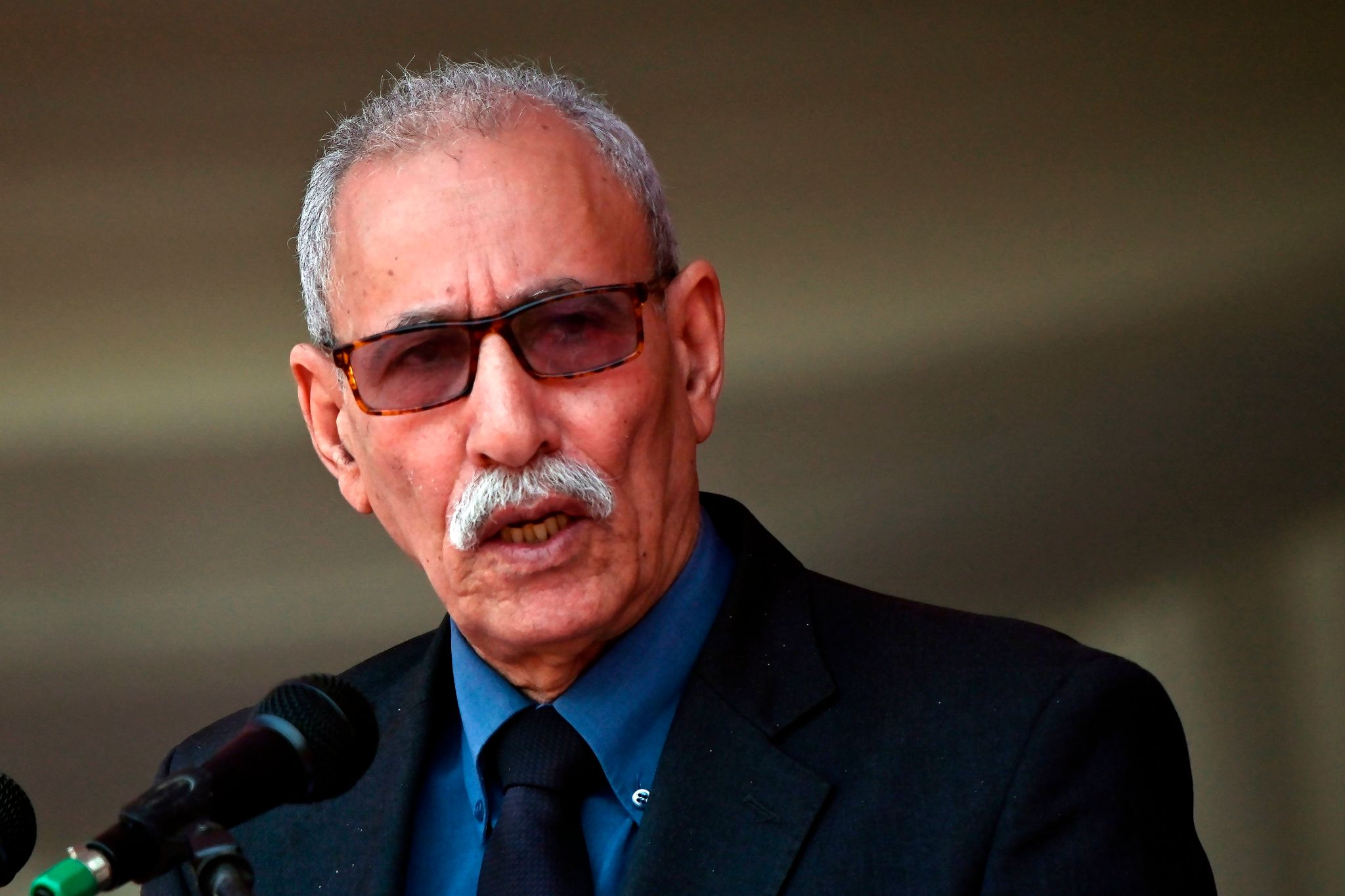
Brahim Ghali, the President of the Sahrawi Arab Democratic Republic (SADR) and Secretary-General of the Polisario Front, reiterated that the UN-African Union (AU) settlement plan “is the only agreed framework for the decolonization of Western Sahara,” which remains under Moroccan occupation, according to the Sahrawi news agency SPS.
In a message directed to UN Secretary-General Antonio Guterres, President Ghali outlined the latest developments concerning the Sahrawi issue, emphasizing its international significance. He noted that the question of Western Sahara is a matter of decolonization listed on the agenda of the UN General Assembly and its subsidiary bodies.
Ghali pointed out that “this year marks the fiftieth anniversary of Morocco’s invasion of Western Sahara on October 31, 1975, a blatant violation of the United Nations Charter and the inalienable right of the Sahrawi people to self-determination and independence.”
Addressing human rights concerns, he stated that “the illegal and ongoing military occupation of Western Sahara by Morocco represents the most serious violation of the Sahrawi people’s right to self-determination, leading to systematic and egregious infringements upon their political, economic, social, and cultural rights.”
He continued, “These violations have been documented and condemned by numerous international organizations, including various African entities and UN bodies.”
Additionally, the Sahrawi president expressed alarm over the situation of political prisoners from Western Sahara, particularly those from the Gdeim Izik group, who “continue to endure tragic conditions in Moroccan prisons, facing daily degrading and punitive practices, such as the denial of medical care, isolation, and prohibition of correspondence.”
In this context, he urged the UN Secretary-General to “take all necessary measures to ensure the immediate and unconditional release of all Sahrawi political prisoners so they can return to their homeland and reunite with their families.”
Furthermore, he condemned the Moroccan occupying authorities for pursuing a scorched earth policy aimed at uprooting Sahrawis from their homes and lands, part of a systematic colonial strategy that includes policies of impoverishment, deprivation, exclusion, and racial discrimination against the Sahrawi people, as well as the plundering of Sahrawi resources in collusion with foreign parties, in blatant violation of the Sahrawi people’s permanent sovereignty over their natural resources.
In this regard, President Ghali referenced two rulings issued on October 4, 2024, by the Court of Justice of the European Union (CJEU). These rulings affirmed the “separate and distinct status” of Western Sahara in accordance with UN General Assembly resolution 2625 (XXV) and declared the illegality of agreements between the European Union (EU) and Morocco that include Western Sahara, noting that these agreements were concluded without the consent of the Sahrawi people and disregarded their right to self-determination and permanent sovereignty over their natural resources.
He also highlighted that “since their violation of the ceasefire on November 13, 2020, Moroccan occupying forces have continued to deploy various types of weaponry, including drones, to kill Sahrawi civilians.” He underscored that “the deliberate targeting of civilians and civilian objects constitutes a war crime under the Rome Statute of the International Criminal Court (ICC) and violates the principles of international humanitarian law.”
He stated that the Moroccan occupation “continues to impose a military siege and an absolute media blackout on the territory, preventing United Nations bodies, their rapporteurs, non-governmental organizations, international media, and observers from entering, all with the aim of concealing its heinous crimes against Sahrawi civilians.”
In this context, Ghali urged the United Nations to “fulfill its moral and legal responsibilities towards the Sahrawi people.” He emphasized the need for establishing an independent and permanent mechanism to protect the fundamental rights of the Sahrawi people, which would also provide regular field reports on the situation in the territory to the relevant United Nations bodies. Additionally, he called for an expansion of the mandate of the United Nations Mission for the Organization of a Referendum in Western Sahara (MINURSO) to include human rights monitoring.
He reaffirmed that the joint UN-African Union settlement plan, accepted by both parties—the Polisario Front and Morocco—in 1988 and unanimously endorsed by the UN Security Council, is “the only mutually agreed-upon plan that is practical and reasonable for achieving a peaceful, just, and lasting solution to end colonization in Western Sahara.”
In this vein, the Sahrawi president reiterated the Polisario Front’s full readiness to engage in “direct, serious, credible, and good-faith negotiations without preconditions with Morocco, aiming to reach a peaceful, just, and lasting solution to end the colonization of Western Sahara, in accordance with the decisions of the United Nations, the African Union, and pertinent principles of international law.”