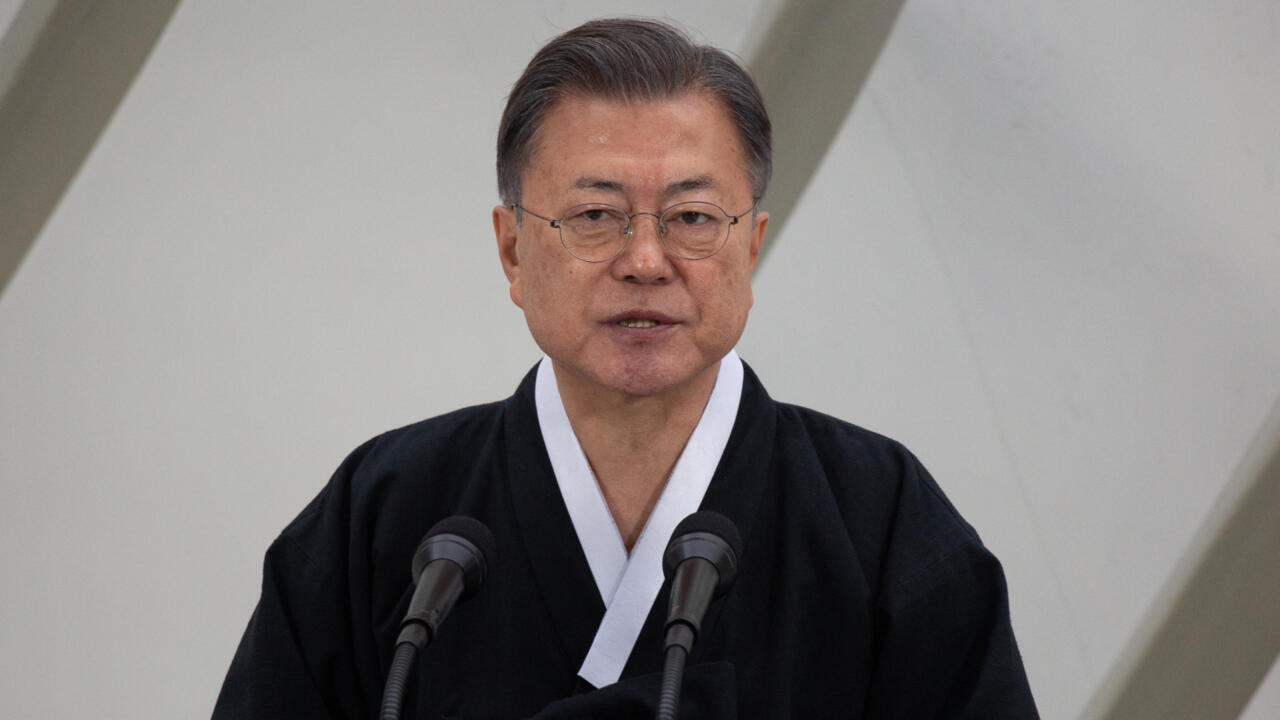
Former South Korean President Moon Jae-in has been charged with corruption for allegedly facilitating the employment of his son-in-law at an airline, prosecutors announced on Thursday.
This development adds another layer of complexity to the already turbulent South Korean political landscape, which has endured months of chaos following former President Yoon Seok Yeol’s unsuccessful attempt to impose martial law in December, resulting in his impeachment.
The center-left former president, who served from 2017 to 2022, was “charged with corruption for receiving 217 million won (approximately €132,200) in connection with his son-in-law’s employment at an airline,” stated the Jeonju district prosecutor’s office in a press release.
According to prosecutors, Mr. Moon’s son-in-law was appointed CEO of Thai Easter Jet “despite lacking any relevant experience or qualifications in the aviation industry.” The company, effectively controlled by a former member of Moon Jae-in’s party, hired his son-in-law in hopes of gaining favor with the president.
Prosecutors further disclosed that all salaries and other financial benefits paid to Mr. Moon’s son-in-law by the airline between 2018 and 2020 “have been confirmed as illegitimate salary payments, but rather bribes intended for the president.”
Moon Jae-in is recognized for his efforts to promote inter-Korean rapprochement, notably organizing discussions between North Korean leader Kim Jong Un and former U.S. President Donald Trump during his first term.
With the indictment of Moon Jae-in, two former South Korean presidents are currently facing legal scrutiny. Mr. Yoon is presently on trial for insurrection after he attempted to impose martial law unexpectedly on the night of December 3-4, 2024, sending troops to block the opposition-controlled Parliament. However, a sufficient number of lawmakers were able to gather and thwart this coup attempt.
If convicted, Yoon could face life imprisonment or even the death penalty. Nevertheless, the likelihood of capital punishment being applied remains low, as South Korea has maintained an unofficial moratorium on executions since 1997.