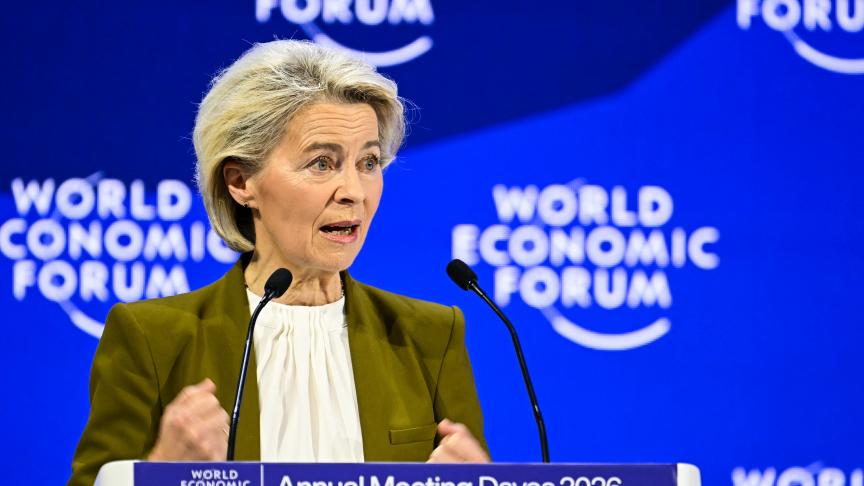
Europe is facing a defining moment as the international order continues to erode, European Commission President Ursula von der Leyen warned on Wednesday, stressing that while the European Union prioritizes dialogue and negotiated solutions, it is fully prepared to act with unity, urgency, and determination if circumstances require. Addressing the European Parliament, von der Leyen said recent global developments demonstrate that the shift in the international system is permanent rather than temporary, obliging Europe to adapt rapidly while firmly defending international law and democratic principles.
Von der Leyen cautioned that the world is increasingly shaped by raw power politics, arguing that Europe must strengthen its own levers of power through a strong economy, a competitive single market, and enhanced technological and innovation capacity. Referring to rising tensions in the Arctic, she emphasized that Greenland should not be viewed merely as a strategic or resource-rich territory but “above all, home to a free and sovereign people,” adding that the future of Greenland is solely for Greenlanders to decide. While reaffirming Europe’s alignment with the United States on Arctic security within NATO, she rejected the use of security arguments to justify additional tariffs between allies, warning that a downward spiral among partners would only embolden adversaries.
European Council President Antonio Costa echoed these concerns, firmly rejecting a global order based on power politics and warning against the erosion of international law. He told lawmakers that the EU “cannot accept that the law of the strongest prevails over the rights of the weakest,” stressing that international rules are not optional and alliances cannot be reduced to purely transactional relationships. Costa said violations of international law and human rights cannot be tolerated anywhere, citing Ukraine, Gaza, Greenland, Africa, Latin America, Iran, Sudan, and Afghanistan.
Costa outlined three pillars for Europe’s response to mounting geopolitical challenges: a Europe of principles, a Europe of protection, and a Europe of prosperity, noting that all are currently under strain amid the war in Ukraine, pressure on the rules-based order, and tensions in transatlantic relations. Emphasizing trade as a strategic tool, he said the EU is expanding global partnerships, including a recently signed agreement with Mercosur and ongoing negotiations with India, arguing that diversified trade strengthens Europe’s resilience and independence. “Instead of tariffs, the European Union offers partnerships,” Costa said, warning that further tariffs would undermine transatlantic relations and violate existing EU–US agreements.