Dutch Media Reveal How Morocco Spies on Its Opponents in the Netherlands and Across Europe

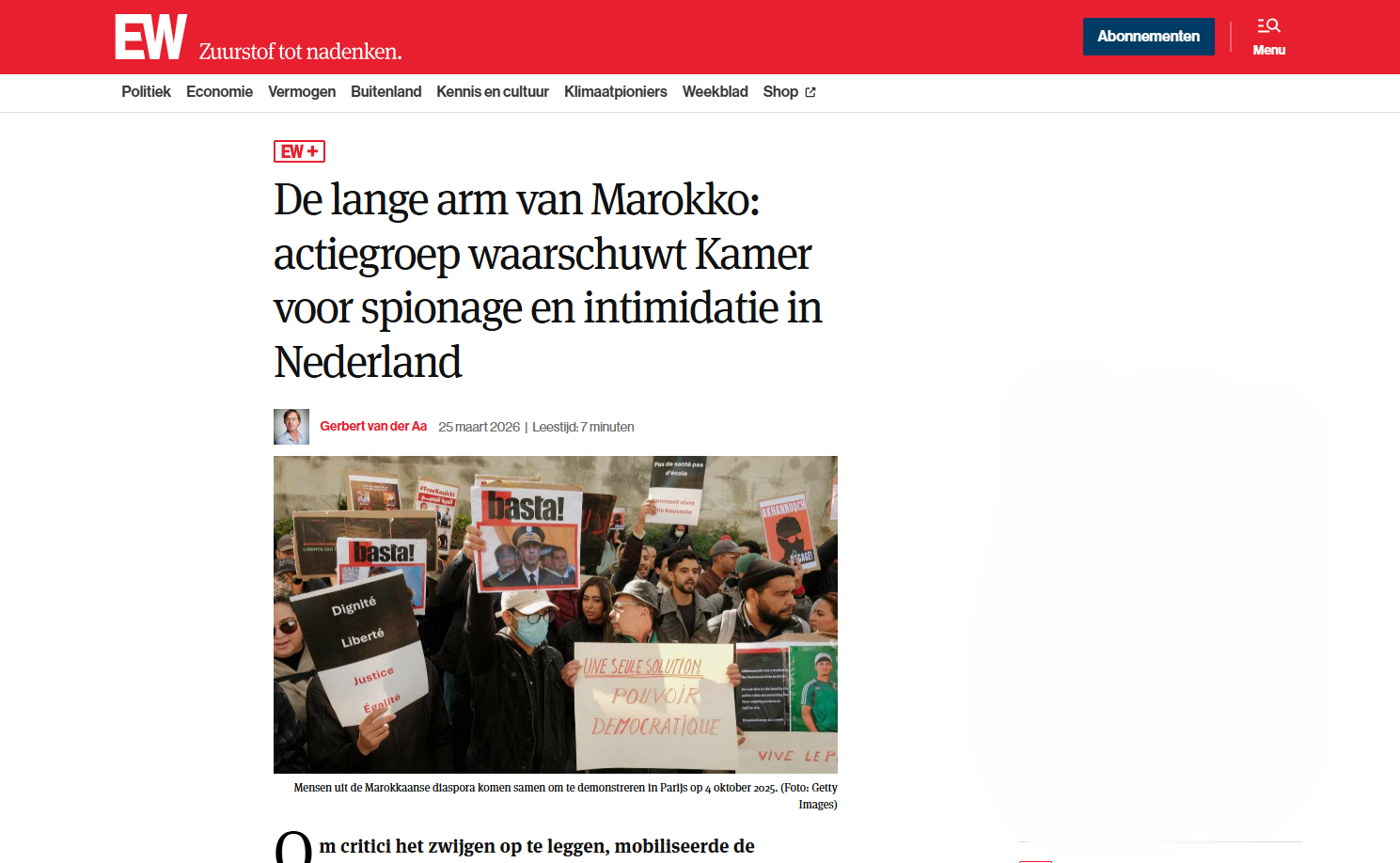
Following explosive revelations, the Moroccan Makhzen regime has been shaken by a new espionage scandal that extends far beyond its borders.
Investigations conducted by Dutch media have brought to light the existence of a surveillance network targeting Moroccan opponents living in exile in Europe, particularly in the Netherlands and Germany.
These revelations have caused a real shock in European political and media circles, with several observers openly denouncing a strategy of interference and intimidation carried out by the Moroccan authorities.
It is now established that the Moroccan regime mobilized its intelligence services to infiltrate Moroccan communities in Europe. Agents reportedly sought to monitor human rights activists, intimidate their families, and use sophisticated surveillance technologies, provided by the Zionist entity, to collect sensitive information.
Moroccan consulates and the embassy are accused of playing a central role in coordinating these operations, reinforcing the impression of organized and systematic interference.
But the matter does not stop there. The collective Monitor Lange Arm Rabat, in a letter addressed to the Dutch Parliament and made public by the news website De Kanttekening, denounces an even broader strategy of influence. According to the group, Rabat resorts to the instrumentalization of religion, the financing of local organizations, and the support of influential figures of Moroccan origin to strengthen its grip.
The recruitment of young athletes for Moroccan national teams and the sending of state-appointed imams during Ramadan are cited as concrete examples of this policy of interference.
Dutch media have also highlighted the scale of Moroccan espionage networks as well as the extent of the influence mechanisms deployed by Rabat. They revealed the involvement of the Makhzen in practices of repression, blackmail, and surveillance targeting Moroccan opponents and human rights defenders.
Moreover, these investigations show how, under the direct directives of the Makhzen, Moroccan consular representations in Europe have been transformed into real instruments of propaganda and influence. Their objective: to exert pressure on citizens, in the Netherlands as elsewhere in Europe, in order to dissuade them from criticizing the Moroccan regime.
According to Dutch media, Moroccan agents were tasked with collecting information on opponents based in the Netherlands as well as on human rights activists. They were also assigned to carry out actions and issue threats aimed at silencing these critical voices.
This espionage scandal reveals, according to Dutch media, a “long arm of Morocco” acting as a persistent shadow over Moroccan communities in Europe. Behind Morocco’s official discourse of cooperation and diaspora engagement lies a policy of surveillance and control that weakens European governments in place.