Algerian Minister of State, Minister of Foreign Affairs, National Community Abroad, and African Affairs, Ahmed Attaf, emphasized on Monday that the Oran Process unveiled a strategic vision for unifying the African voice and enhancing its influence and resonance within the UN Security Council, as the foremost and most important forum for multilateral international action in the field of international peace and security.
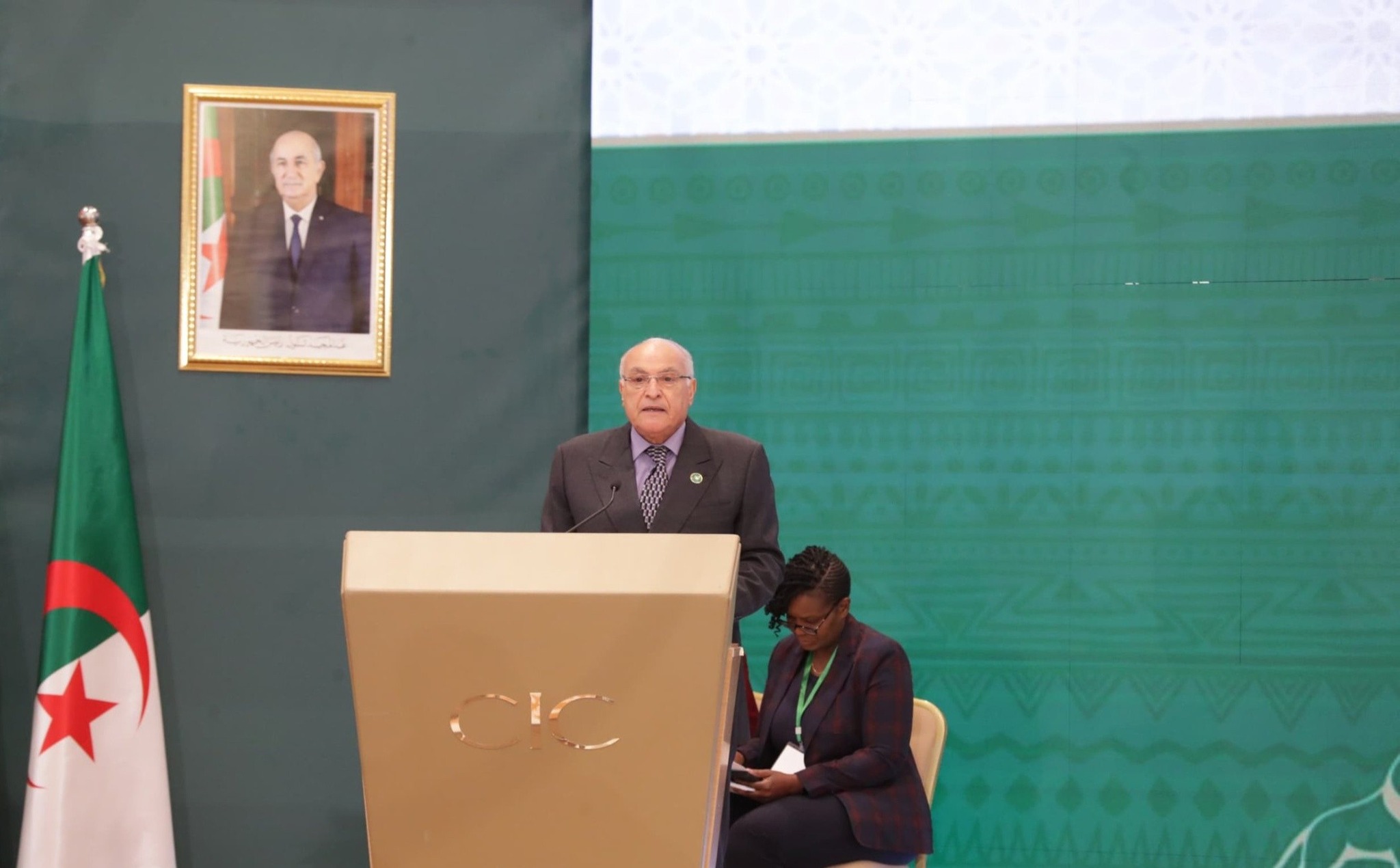
In his opening remarks at the 12th edition of the High-Level Seminar on Peace and Security in Africa, the Oran Process, Ahmed Attaf said that this edition is held to reflect on the remarkable progress achieved toward realizing this strategic vision and translating it into a tangible and perceptible reality within the frameworks of the United Nations and in the resolutions of its Security Council.
African Unity Behind the Oran Process
The Algerian Minister highlighted that the Oran Process has become a firmly established continental event, officially inscribed on the agenda of the continental organization and its esteemed body, the African Peace and Security Council. Moreover, the three African countries on the Security Council have come to form a single, unified bloc— a bloc known by name, with a solid identity, firm positions, and whose stances and perspectives are respected and taken into account. He added that Africa has reached a level never attained by any continent before—a level where its members on the UN Security Council are mandated to advocate for the continent and its priorities, “not through separate and individual national voices, but through a single, unified voice: the voice of the entire African continent.”
These achievements “would not have been possible without the commitment of all African states and their rallying around the objectives sought by the Oran Process. All praise—every praise—is due to all the countries of our continent that have successively held the three African seats on the Security Council since the launch of this process in its first edition, up to this current edition,” Attaf said.
Algeria at the Core of African Unity
Ahmed Attaf expressed Algeria’s honor in being an active partner in this endeavor, both as the host country of the Oran Process and, beyond that role, as a member of the UN Security Council and the African Union Peace and Security Council.
“As we prepare to conclude our Security Council mandate, we hope that we have fulfilled the responsibilities entrusted to us toward our continent and our African brothers and sisters,” he said, adding that together with “the Federal Republic of Somalia and the Republic of Sierra Leone, we endeavored to form a cohesive bloc within the Council—one that expresses African positions, not national ones, whenever matters of peace and security in our continent arise.”
He emphasized that in doing so, “we ensured that our positions were grounded in AU decisions, that our initiatives aligned with the guidance of the AU Peace and Security Council, and that our actions remained fully consistent with Africa’s longstanding doctrine on preventing the root causes of tension and conflict.”
In this regard, Attaf expressed his wishes of success to the successors on the UN Security Council—the Democratic Republic of the Congo and the Republic of Liberia.
Security Challenges Amid Global Apathy
The Algerian Minister stressed that the current international context is far from ordinary. It is a moment of profound crisis, deep instability, and acute complexity—a moment marked by polarization, division, and conflict; in which there is a sweeping push to undermine the most precious achievements humanity has secured since the dawn of history.
These achievements encompass the supremacy of international law among nations, multilateralism as a framework for cooperation against shared challenges, and the United Nations as a beacon of justice and law, and as a common space for dialogue, convergence, and conflict resolution.
He added that such a context inevitably imposes additional challenges upon Africa, particularly amid the diminishing and fading international focus on peace and security issues in the continent—”issues that have steadily slipped down the ladder of global priorities.”
This comes as the war in Sudan is close to entering its third year, leaving in its wake the world’s gravest humanitarian crisis—with no glimmer of the long-awaited political settlement that would end the suffering of the Sudanese people.
The crisis in Libya, now in its fourteenth year, has become a forgotten issue at the continental and international levels, as though all have resigned themselves to the logic of internal factions and foreign interferences, treating the crisis as an inescapable fate.
The last colony in our continent marks this year sixty-two years since the international community promised, upon inscribing Western Sahara on the list of Non-Self-Governing Territories, to enable its people to exercise their inalienable and imprescriptible right to self-determination—consistent with relevant international legality and the UN’s established doctrine on decolonization.
Conditions in the Sahel-Sahara region have exceeded every threshold of crisis—security-wise, politically, and economically—without any meaningful initiative emerging, whether to address unconstitutional changes of government, now entrenched as faits accomplis, or to confront the scourge of terrorism, which has expanded and intensified at unprecedented levels.
“Likewise, the situations in other parts of our continent—particularly the Great Lakes region and the Horn of Africa—demonstrate that the absence of lasting and sustainable solutions leads only to the recurrence of crises in even more severe and dangerous forms,” Attaf said.
Revitalizing African Diplomacy
On the other hand, Attaf said that such a reality requires holding up “the mirror to ourselves before turning it toward others, and to question our own actions before questioning those of others.”
In this regard, he noted that the retreat of continental diplomatic engagement has, regrettably, become a defining feature of Africa’s peace and security landscape. Besides, Africa’s limited attention to its own hotspots of tension has been a principal factor in diminishing their visibility on the global multilateral agenda. Furthermore, he stressed that the scarcity of African initiatives to mend conflicts and prevent wars has opened wide the door to ever-increasing external interventions.
“Africa today is in dire need of revitalizing its diplomatic role, of designing and activating African solutions to African problems, and of reviving its diplomatic tradition—one whose effectiveness has been proven throughout its modern and historical trajectory,” the Algerian Minister said.
He highlighted that this diplomatic tradition is grounded in a strong presence at sites of crisis and conflict. Moreover, it is built on purposeful engagement with all stakeholders wherever they may be. Additionally, it is driven by proactive mediation initiatives that close the pathways to escalation and complexity.
“This is the challenge before us today. Its fulfillment is unquestionably a shared collective responsibility of all member states and the relevant regional economic communities, in collaboration with our continental organization—the African Union. The African members of the UN Security Council will remain a support, an extension, and an amplifier of this purely African effort at the international level.”
Accordingly, Minister Ahmed Attaf reiterated that Africa’s strength lies within itself. “This is not to downplay the necessity of continuing to fight for the place our continent deserves in all global decision-making centers—political, security, and economic. Rather, it echoes the timeless words of the late African leader Kwame Nkrumah,” who affirmed that “the forces that unite us are intrinsic and greater than the superimposed influences that keep us apart.”