Algeria-Oman: Opportunities to Enhance Bilateral Cooperation

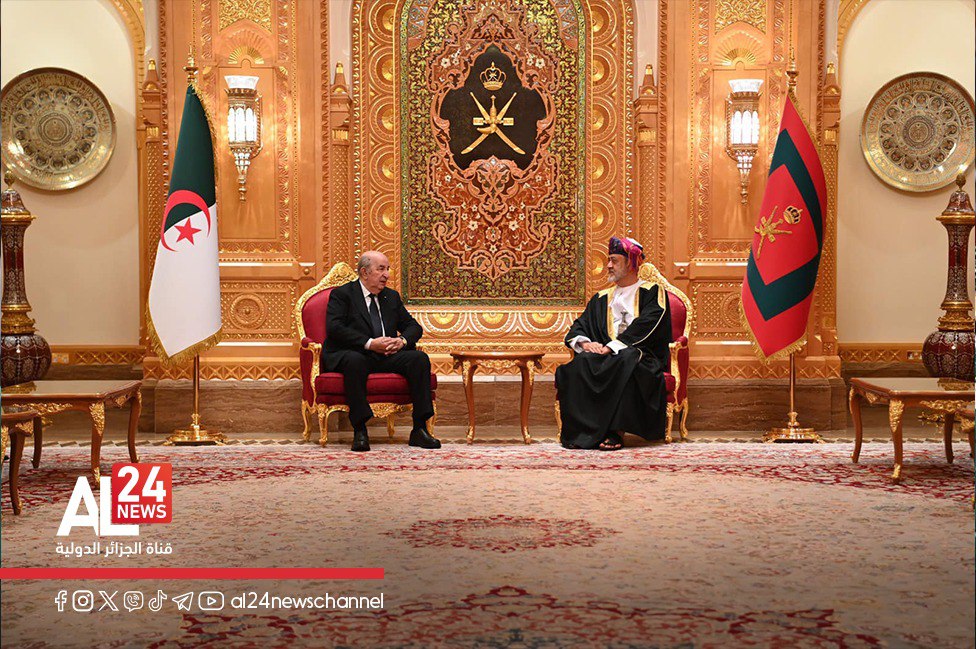
The historic state visit by Algerian President Abdelmadjid Tebboune of Algeria to the Sultanate of Oman, where he will engage in discussions with Sultan Haitham bin Tariq, aims to further strengthen the political and economic ties between these two brotherly nations. Both countries are committed to expanding bilateral cooperation and partnership, recognizing the significant potential and opportunities available.
Algeria and Oman share a long-standing relationship characterized by aligned perspectives and high-level political coordination, particularly concerning Arab and international issues. The two nations have consistently collaborated to enhance bilateral relations and maintain coordination on conflict resolution, favoring dialogue and political solutions to promote peace and stability in the region.
This ongoing consultation has fostered strong connections between the leaders of both countries and their respective peoples, as evidenced by joint meetings and exchanges of visits among senior officials, parliamentarians, and business leaders, alongside the signing of numerous memorandums and cooperation agreements.
Notably, the 8th session of the Algerian-Omani Joint Commission, held last June in Algiers, reaffirmed the alignment of views between the two nations in addressing various regional and international challenges. During this event, Algeria’s Minister of Foreign Affairs and National Community Abroad, Ahmed Attaf, emphasized “the promising and beneficial dynamics” characterizing Algerian-Omani relations recently, which he believes signal “great prospects that we wish to explore in the best possible manner, for the benefit of our bilateral relations and the causes of our Arab-Islamic nation.”
In turn, Oman’s Minister of Foreign Affairs, Badr bin Hamad bin Hamoud al Busaidi, highlighted “the deep-rooted values of fraternity shared between the two nations and peoples,” underscoring “the importance of bilateral relations grounded in unwavering respect, a consistent approach, and profound understanding.”
Economic Projects to Strengthen Cooperation
Economic cooperation between Algeria and Oman is exemplified by a robust partnership across various sectors, particularly in energy. A notable initiative is the joint venture “AOA” for the production of fertilizers (urea and ammonia), co-owned by the Omani company SPGH and Algerian Sonatrach Group.
This facility commenced production in 2017, generating over 2.4 million tons of urea and 1.35 million tons of ammonia annually, fulfilling both local market needs and export demands.
Both nations have also launched additional projects in renewable energy, Saharan agriculture, pharmaceuticals, mineral resources, and other priority sectors.
Numerous agreements signed between the two countries aim to bolster and encourage bilateral partnerships in trade and investment. These include pacts to prevent double taxation, mutual encouragement and protection of investments, as well as the establishment of an Omani-Algerian Business Council.
In the hydrocarbons sector, there are substantial opportunities for developing partnerships in gas field exploration, production, and hydrocarbon transportation.
In April of last year, the Sonatrach group signed a memorandum of understanding (MoU) in Muscat with OQ Exploration & Production, a subsidiary of OQ Global Integrated Energy Company, to explore opportunities for collaboration in hydrocarbon exploration and production activities.
The two countries also maintain ongoing communication within the frameworks of both OPEC and non-OPEC cooperation, united by a shared objective of stabilizing oil markets.
Observers highlight that Algeria and the Sultanate of Oman possess unique advantages and potential that could bolster economic and trade exchanges, particularly due to their strategic geographic locations. Algeria acts as the northern gateway to the African continent, benefiting from a significant sphere of influence, and is conveniently located just an hour’s flight from Barcelona or Marseille in Europe.
Oman, on the other hand, serves as a pivotal entry point for Gulf countries, positioned at the crossroads of maritime routes connecting China, India, and the wider Asian continent.
This strategic positioning enables Oman to function as a hub for Algerian products destined for Gulf markets, East Africa, and Asia, while Algeria can facilitate the export of Omani goods to Europe, the Maghreb region, and sub-Saharan Africa.
Two ports have the potential to serve as key gateways for Algerian exports and attract investments: Salalah Port, recognized as the second most efficient port globally with 50 direct connections across various maritime routes, and Duqm Port, which specializes in energy and mining products. The Duqm region is also renowned for its abundant fishery resources and aims to establish itself as a center for fish processing industries and aquaculture projects.
Furthermore, Oman aspires to be a leader in renewable energy technologies by hosting major global initiatives in green hydrogen, a goal that aligns with Algeria’s ambition to position itself as a significant player in Africa in this sector by developing substantial production primarily aimed at export.
In terms of transportation, establishing a direct airline route between the two capitals would greatly enhance tourism by showcasing the wealth of both nations and facilitating high-level economic exchanges.