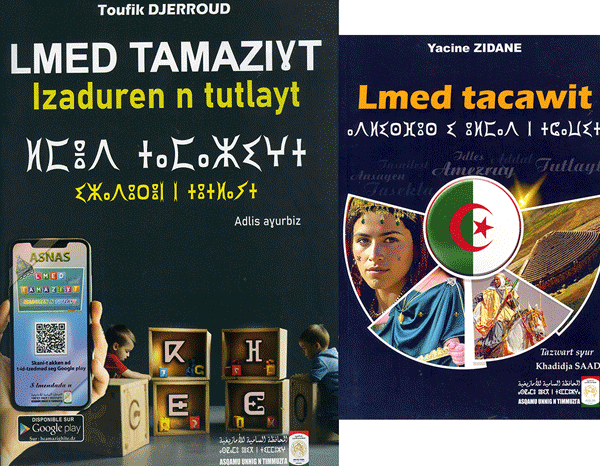
The High Commission for Amazighity (HCA) has recently released three educational works in Tamazight, aimed at promoting and expanding the learning and teaching of this national and official language.
These publications are designed for researchers, Tamazight language teachers, and students enrolled in literacy and adult education programs, to enhance language acquisition both within academic contexts and outside traditional educational frameworks.
The new titles include “Lmed Tacawit” by Yacine Zidane, “Lmed Tamazight, izaduren n tutlayt” by Toufik Djerroud, and “Aselmad Asendwal n tamazight i yimeqqranen,” all of which enrich the HCA’s editorial catalog.
Yacine Zidane, the author of “Lmed Tacawit” (Learning Shawiya), a variant of Tamazight spoken in the Aurès region and its surrounding areas, asserts that his work aims to “contribute to the promotion and research of Tamazight in its various forms.”
Divided into three chapters, the book provides a thorough overview of the Chaoui region, examining its history, cities, and local culture, particularly as expressed through song, music, and jewelry.
In the first chapter, the author offers insights into the region’s history and culture, illustrated through various artistic expressions such as song, sewing, and dance, along with profiles of notable figures who have influenced its history over time.
The second chapter emphasizes the linguistic characteristics of the Chaoui variant, discussing phonetics, morphology, and syntax. The final chapter introduces specific terminologies across four linguistic variations: Kabyle, Shawiya, Arabic, and French.
In the educational realm, Toufik Djerroud’s publication, “Lmed tamazight, izaduren n tutlayt” (Learning Tamazight: The Basics of the Language), serves as an essential resource for beginners learning the Amazigh language.
Comprising 12 chapters, this comprehensive educational manual provides basic lessons for learners, covering vocabulary across various themes including numbers (Uttunen), colors (Initen), geometric shapes (Talghiwin), animals (Ighersiwen), seasons and days, as well as aspects of nature, among others. Another significant work, “Aselmad Asendwal n tamazight i yimeqqranen” (Pedagogy of Teaching Tamazight for Literacy Classes and Adult Education), compiles proceedings from training sessions aimed at Tamazight teachers for adults held in Biskra, targeting adult learners to improve their reading and writing skills in this language.
This collective endeavor brings together contributions from educators engaged in teaching the Amazigh language to adults (andragogy) and aims to provide “language teaching services to adults outside formal educational settings,” as emphasized by the HCA in its introduction.
The HCA noted that these titles represent “a valuable addition to previously published references,” adding that they will be “accessible” on the HCA’s website.