Algeria, Netherlands Discuss Strengthening Bilateral Cooperation

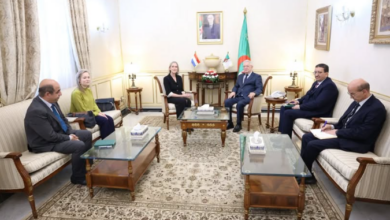
The Speaker of the Algerian Council of the Nation (Parliament’s Upper House), Azouz Nasri, received the Ambassador of the Kingdom of the Netherlands to Algeria, Anne Luwema, for a courtesy visit on Wednesday, the Upper House said in a statement.
During the meeting, Nasri praised the “historical ties” between the two countries. He affirmed that under the leadership of the President of the Republic, Abdelmadjid Tebboune, “Algeria looks forward to working with the new Dutch government to give a significant and renewed momentum to bilateral relations, within a framework of trust, mutual respect, and shared interests.” Both sides explored the current state and prospects of relations, highlighting “the ongoing political dialogue and promising economic potential.” The Speaker noted that Algeria’s foreign policy based on political realism, balance, and mutual interest adopts a constructive approach to international partnerships. According to him, this approach aims to foster national development and regional stability while respecting international law, non-interference, and the right to self-determination.
“This constitutes a solid foundation for the consolidation of bilateral cooperation in various fields,” he added.
Regarding economic cooperation, Nasri stressed the importance of elevating ties to match “the level of available potential,” notably in energy, renewables, agriculture, food industries, water management, and support for start-ups. He underscored the guarantees provided by Algeria’s new investment legislation, which enhances market attractiveness for Dutch operators.
On regional and international matters, Nasri stated that shifting global dynamics “require reinforcing the principles of dialogue, pluralism, and strict commitment to international legitimacy.” He reiterated Algeria’s commitment to the peaceful resolution of conflicts and stability in the Sahel. Touching on migration, the Speaker underscored Algeria’s “comprehensive approach,” which addresses the root causes of illegal migration, such as lack of development.
Nasri further highlighted parliamentary diplomacy as a “complementary pillar of executive work,” urging for the activation of cooperation mechanisms and increased exchanges between friendship groups to ensure the sustainability of bilateral relations.
For her part, Ambassador Luwema expressed her pride in working in Algeria, praising the country’s regional standing.
She reaffirmed the new Dutch government’s readiness to “continue dialogue and cooperation across various sectors, including energy transition, scientific research, sports, and culture.” The ambassador also commended the warm welcome she received and noted the depth of historical ties dating back to 1616, when the Netherlands established its first consulate in Algiers.
Both sides reiterated their commitment to elevating bilateral relations to higher levels, reflecting “a shared political determination to build a balanced, effective partnership with a future vision.”