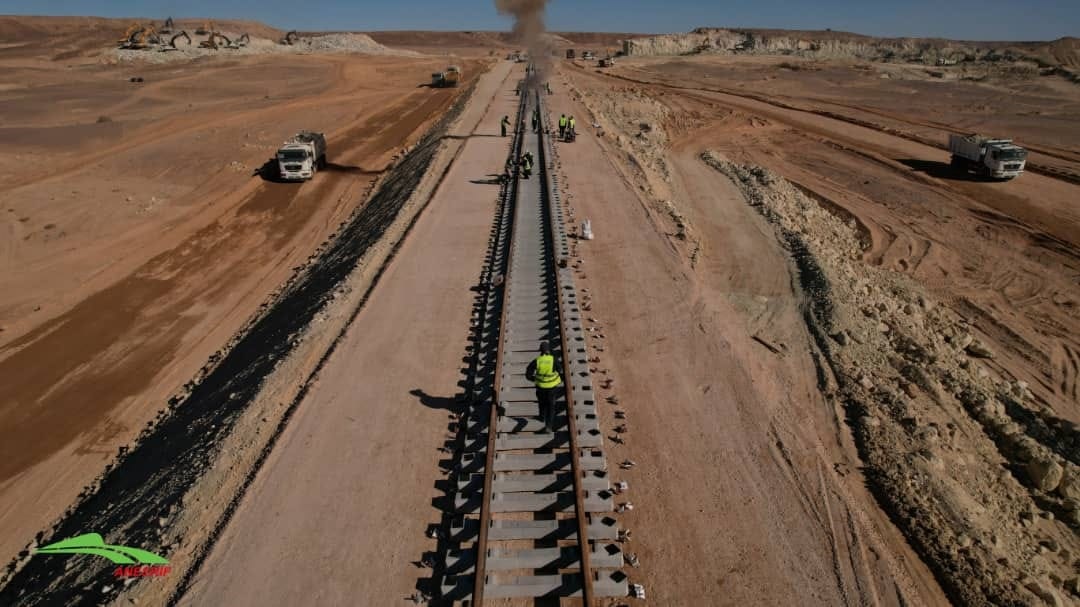
The construction of the western Algerian mining railway line megaproject linking Bechar, Beni Abbes, Tindouf and Gara Djebilet across nearly 950 km represents one of 2025’s most significant infrastructure projects and a crucial catalyst for national industry and economic development.
The President of the Republic Abdelmadjid Tebboune launched construction on this megaproject in November 2023, which economic experts view as a major milestone for the economic and social development of the country’s southwestern provinces.
The new railway line will expand the national network, modernize the mining industry, and connect the Gara Djebilet mining zone and other provinces, including Bechar and Beni-Abbes, to industrial and port centers in the northwest over a total distance of nearly 2,000 km.
The line will also play a crucial role in developing the country’s steel industry, they said, underlining that its operation will improve access to mineral resources in the southwest, enhance steel industry capacity, and significantly boost job creation.
According to Abdessamad Boudi, director of the Laboratory for Economic Studies and Local Development of the Southwest at the University of Bechar, the project’s impact will be long-lasting, both in terms of exploiting the Gara Djebilet iron deposits and advancing rail transport infrastructure.
Exploiting this deposit, now made feasible, represents a transformative project capable of shaping the region’s and country’s industrial and mining future.
The megaproject is also part of an approach that balances natural resource extraction with sustainable development requirements and will contribute to diversifying the national economy and reducing dependence on hydrocarbons, he said.
For his part, Economist and UTMB lecturer Mebarek Benzair emphasized that the railway will strengthen the national mineral transport network and revitalize mining operations as well as domestic freight and passenger travel.
He pointed out that the project has opened up previously isolated areas, including the border town of Tabelbala, located 424 km south of Beni Abbes. Integration into the national network should fundamentally reshape the region’s economic and social landscape, particularly through planned iron processing and manufacturing facilities along the route through Bechar, Beni Abbes, Tindouf, Naama provinces and into the northwest.
In this respect, the National Agency for Railway Investment Studies and Implementation Monitoring (ANESRIF) has maintained daily oversight of the project since construction began.
The work was entrusted to consortiums of public companies, collaborating on certain sections with Chinese partner China Railway Construction Corporation Limited (CRCC), according to the agency’s central communications director, Abdelkader Mazar.
He underscored that the megaproject’s construction sites, which created over 8,000 jobs for managers and supervisors, have undergone rigorous daily monitoring by the agency’s executive management, experts, and technical staff.
“This oversight ensures adherence to timelines and compliance with national and international standards for both technical infrastructure and the 1,431 engineering structures, including 45 railway bridges, 48 road bridges, and 1,338 hydraulic facilities, along the route through the Saharan regions of the provinces of Bechar, Beni-Abbes, Tindouf and Gara Djebilet,” he added.
The 45 railway viaducts span a combined 20 kilometers, according to project director Abdechafii Benrabi.
These structures, built to cross regional rivers and wadis, include the railway bridge over Oued Daoura in Tindouf province, at 4.1 km, now the longest railway bridge in both Algeria and Africa. The structures were completed between July 2024 and November 2025, said Benrabi.
Originally scheduled for phased delivery between March and June 2026, the project was completed in record time thanks to the expertise of ANESRIF managers and technical staff, demonstrating the exceptional capabilities of ANESRIF, the public companies, and Chinese partner involved in execution, according to local technical officials from provinces covered by the megaproject.
In Oran, the connection works of the Bethioua industrial zone to the Hassi Mefsoukh–Mostaganem railway line, from the mixed station of El Ayaïda, were completed at the beginning of the current year.
The execution of this project, 7.3 km long, was taken in charge by three national companies, according to information collected from the local directorate of transport.
The Bethioua line project, ready to be operated, includes four engineering works, including two overpasses and two underpasses, as well as 14 hydraulic structures and one protection structure along the route.