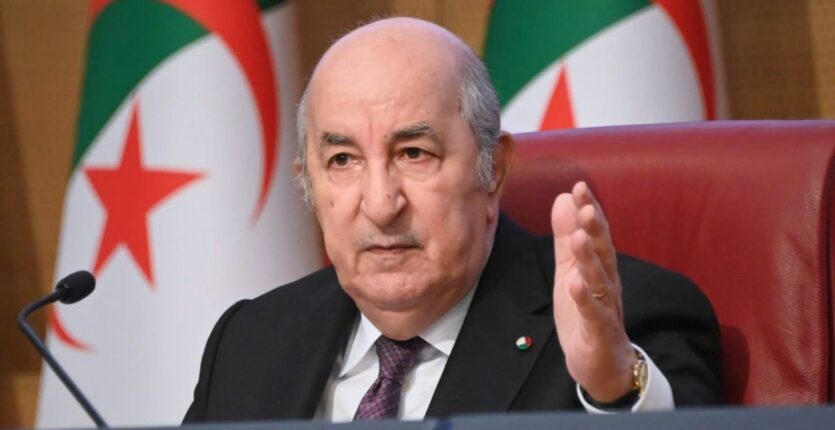
Algerian President, Abdelmadjid Tebboune, called on Sunday for the establishment of an explicit and unequivocal international recognition—by United Nations organizations and colonial powers—of the criminal nature of practices that included enslavement, forced deportation, ethnic cleansing, torture, displacement, and systematic persecution.
This was in an address delivered on his behalf by Prime Minister, Sifi Ghrieb, in a meeting devoted to examining the implications of recognizing colonialism as a crime against humanity, as well as to classifying certain acts committed during the periods of enslavement, forced deportation, and colonialism as acts of genocide against the peoples of Africa, based on the study prepared by the African Union Commission on International Law.
The meeting was held on the sidelines of the 39th Ordinary Session of the Assembly of Heads of State and Government of the African Union, in the Ethiopian capital, Addis Ababa.
The Algerian President said the study conducted by the AU Commission on International Law highlights the legal consequences arising from classifying colonialism as a crime against humanity, as well as from characterizing certain practices associated with the periods of enslavement, forced deportation, and colonialism as acts amounting to the crime of genocide against African peoples.
In this regard, President Tebboune commended this distinguished scientific and legal effort, affirming Algeria’s full and steadfast support for all initiatives undertaken by the African Union Commission and its specialized legal bodies aimed at establishing a clear and explicit legal approach that classifies colonialism among the gravest international crimes. Such efforts, he noted, would strengthen the principles of accountability, enshrine the non-impunity principle, and contribute to the establishment of fair historical justice.
He also expressed Algeria’s full readiness to make available all documents, material evidence, and reliable historical testimonies in its possession to the relevant African legal bodies. This offer stems from Algeria’s bitter national experience, which lasted more than 132 years of extremely harsh settler colonialism, highlighting the scale of atrocities and serious violations committed to suppress the resistance of the Algerian people, including widespread repression and the use of methods and means prohibited under international law.
In this context, he referred to Algeria’s initiative, in cooperation with the African Union Commission, to organize a high-level international conference on November 30 and December 1, 2025, under the theme: “Crimes of Colonialism in Africa: Toward Establishing Historical Truth and Criminalizing Colonialism.” The conference culminated in the adoption of the “Algiers Declaration,” which contains a set of recommendations, the most prominent of which include calling for the official recognition of colonial crimes, working to explicitly criminalize colonialism under international law, and strengthening the documentation of colonial crimes and the preservation of African historical memory as an integral part of historical justice.
The President of the Republic also expressed Algeria’s satisfaction with the adoption of its proposal to designate an official African day to commemorate the martyrs of Africa, to be observed annually on November 30. This initiative contributes to strengthening historical awareness among future generations and preserving the memory of the sacrifices made by the peoples of the continent.
Sovereignty in Action
President Abdelmadjid Tebboune addressed the step taken by Algeria at the national level, describing it as an “important sovereign step.” On December 24, 2025, the Algerian Parliament unanimously voted for a law criminalizing the colonialism Algeria suffered. The law aims to establish legal responsibilities, preserve the national memory, and reinforce the principle that serious crimes do not expire, as a fundamental cornerstone of any genuine approach to historical reconciliation.
The law also classifies practices such as extrajudicial executions, torture, rape, nuclear testing on civilians, and the systematic plundering of resources as crimes that are not subject to a statute of limitations, based on the principles of international law and the rights of peoples to truth and justice.
The President emphasized that the great sacrifices made by millions of Africans in the pursuit of freedom, dignity, and justice cannot be erased by forgetfulness or reduced to fragmented narratives. He affirmed that acknowledging historical truth is not a selective recollection of the past, but a moral and legal duty, and a fundamental basis for building balanced international relations grounded in mutual respect, fairness, and the preservation of human dignity.
He also affirmed that Algeria, placing this path at the heart of its priorities, believes that consolidating historical truth and justice forms a solid foundation for more balanced future partnerships and for a world governed by law rather than the logic of force.