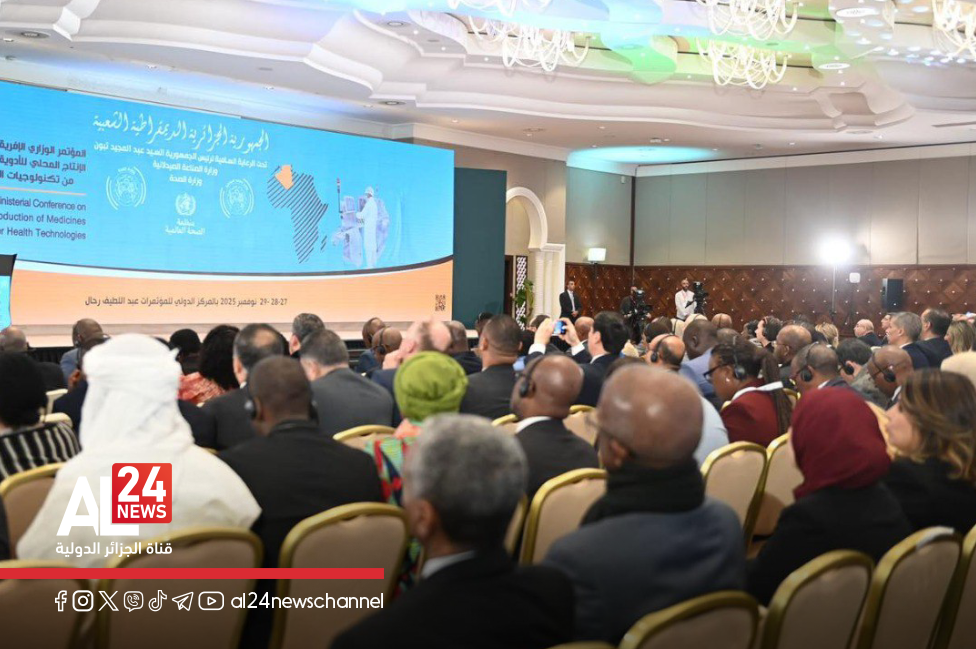
Participants in the Ministerial Conference on Local Production of Medicines and Other Health Technology in Africa adopted on Friday the “Algiers Declaration,” which constitutes a common platform to reinforce the continent’s health sovereignty, through unified efforts to develop the African pharmaceutical industry and reduce dependency on imports.
This Declaration crowns two days of discussions between health ministers, pharmaceutical-industry ministers and representatives of African and international bodies attending the conference — held at the “Abdelatif-Rahal” International Conference Center in Algiers, under the high patronage of President of the Republic, Abdelmadjid Tebboune.
The Declaration, whose text was read by the Minister of Pharmaceutical Industry, Ouacim Kouidri, was adopted by the 29 countries participating in the conference, namely: Algeria, South Africa, Angola, Benin, Botswana, Burkina Faso, Cameroon, Congo, Democratic Republic of the Congo, Djibouti, Egypt, Ethiopia, Gabon, Ghana, Côte d’Ivoire, Kenya, Madagascar, Mozambique, Niger, Nigeria, Rwanda, Senegal, Sierra Leone, Tanzania, Chad, Togo, Uganda, Zambia and Zimbabwe.
The Algiers Declaration includes 13 collective commitments by participating African countries, reflecting a shared vision aimed at guaranteeing the continent’s health security.
These commitments concern reinforcing manufacturing hubs for pharmaceuticals and vaccines locally and regionally across Africa, leveraging the opportunities offered by the African Continental Free Trade Area (AfCFTA), as well as encouraging sustainable public-private partnerships to increase industrial capacity and stimulate long-term investment.
The African countries involved also commit to strengthening national regulatory agencies, accelerating regulatory harmonization through the African Medicines Agency and the African Medicines Regulatory Harmonization Program, while ensuring quality, safety and effectiveness of health products. Institutional development plans aimed at achieving at least regulatory maturity level 3 will contribute to realizing this objective.
Moreover, the Declaration foresees support for mutual recognition of regulatory decisions within regional blocs to facilitate faster access to quality medicines, vaccines and medical devices, support for the role of the African Pharmaceutical Technology Foundation (FATP) and other mechanisms dedicated to technology transfer, access to intellectual property and promotion of local innovation.
Cooperation between universities, research institutes and industry will also be reinforced to develop human capital and build innovation ecosystems.
Continental and international financial institutions — notably the African Development Bank (AfDB), the African Export–Import Bank (Afreximbank) and the Islamic Development Bank (IsDB) — are invited to set up innovative financing mechanisms for manufacturers and acquiring entities, and to facilitate access for African buyers to preferential loans to guarantee stable demand and encourage local production.
The Declaration further calls for a unified medicine procurement mechanism at regional and continental levels to guarantee market access for locally produced medicines, ensure competitive pricing through economies of scale, reduce demand fragmentation, and strengthen equitable access to medicines, vaccines and medical equipment for all African populations, as well as integrate local production into primary health care policies to ensure equitable access — in line with universal health coverage objectives.
Regular exchange between African countries, regulatory authorities, industry representatives and partners will be maintained to assess progress, identify challenges to strengthening African pharmaceutical sovereignty, and encourage member countries to integrate these commitments into their national policies and strategies.
According to the document, the Algiers Declaration comes as part of concretizing the aspirations of the 2063 Agenda of the African Union — whose goals include strengthening health systems — taking into account the “negative fallouts of the COVID-19 pandemic on global supply chains for health products.”
It also asserts the “urgent” need to develop sustainable local production capacities, strengthen regulatory convergence and guarantee access to financing for producers and buyers.
The African countries participating in the conference expressed, via the Algiers Declaration, their appreciation for the role of Algeria as host country, and for its progress — having covered more than 82% of national pharmaceutical needs through local production.