UN Security Council: Algeria Reaffirms Commitment to Sharing Expertise in Combating Terrorism

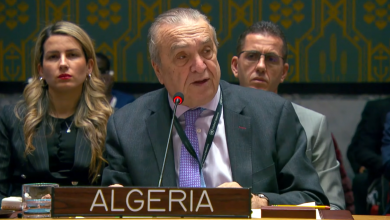
Algeria reaffirmed its commitment Tuesday, in New York, to sharing its expertise, strengthening partnerships and supporting a comprehensive regional response to terrorism, once again emphasizing that combating this threat and its financing remains at the top of its national and regional priorities.
During a Security Council briefing on “Strengthening regional cooperation to combat terrorism in West Africa and the Sahel,” held under the agenda item “Consolidating Peace in West Africa,” Algeria’s Permanent Representative to the UN, Amar Bendjama, said that violence in the Sahel cannot be seen as isolated events but rather as “violence that has evolved into a structural, wide-scale threat, as terrorist groups have expanded both their geographical reach and operational capacities, forged links with international criminal networks, and developed independent financing systems based on drug trafficking and kidnapping for ransom.” Bendjama added that “this escalation stems primarily from our fragmented collective efforts,” underlining that “economic gaps and lack of coordination among stakeholders have created conditions that these groups exploit to expand their influence.” He emphasized that Algeria “prioritizes combating terrorism and its financing in its national and regional commitments,” a stance rooted, he said, in “a painful and extremely difficult national experience that reinforces its leadership in driving and coordinating the African Union’s counter-terrorism agenda, as reflected in the 1999 Algiers Convention, which continues to guide continental strategies.” In this regard, Bendjama reiterated “Algeria’s commitment to sharing its expertise, strengthening partnerships and supporting a comprehensive regional response to terrorism,” pointing out that Algeria emphasized this stance during its Security Council presidency.
He said that this commitment “is particularly crucial in our shared neighborhood, given our borders with several Sahel nations that are among those hardest hit by terrorism.” Regarding a collective response to terrorism in the Sahel and West Africa, Bendjama outlined key priorities, stressing that “regional coordination is the only viable approach to building capacity and addressing this shared threat together rather than individually.” He also emphasized the need to better align various platforms and initiatives across West Africa to enhance coordination, noting that this can be accomplished by learning from existing African Union mechanisms, including the Committee of Intelligence and Security Services of Africa (CISSA), the African Union Mechanism for Police Cooperation (AFRIPOL), and the African Centre for the Study and Research on Terrorism, all designed to promote coherence and support collaborative efforts.
Bendjama further underscored the importance of consolidating efforts under a comprehensive regional strategy backed by all countries in the region to ensure effective action and optimal resource mobilization, along with a unified vision that would encourage partners to provide material and financial support to regional initiatives.
“We fully recognize that building trust among the region’s political leaders may take considerable time, but the imminent threat demands that we at least maintain communication through security cooperation and intelligence sharing,” he said.
To forge a unified response to terrorism in the Sahel and West Africa, Bendjama stressed the need to cut off terrorist groups’ funding streams through enhanced financial monitoring, combating illicit trafficking networks, and strengthening asset tracking and freezing capabilities.
He also emphasized addressing the root causes fuelling terrorism alongside implementing security measures.