Algeria, Zimbabwe Launch Business Council for Enhanced Cooperation

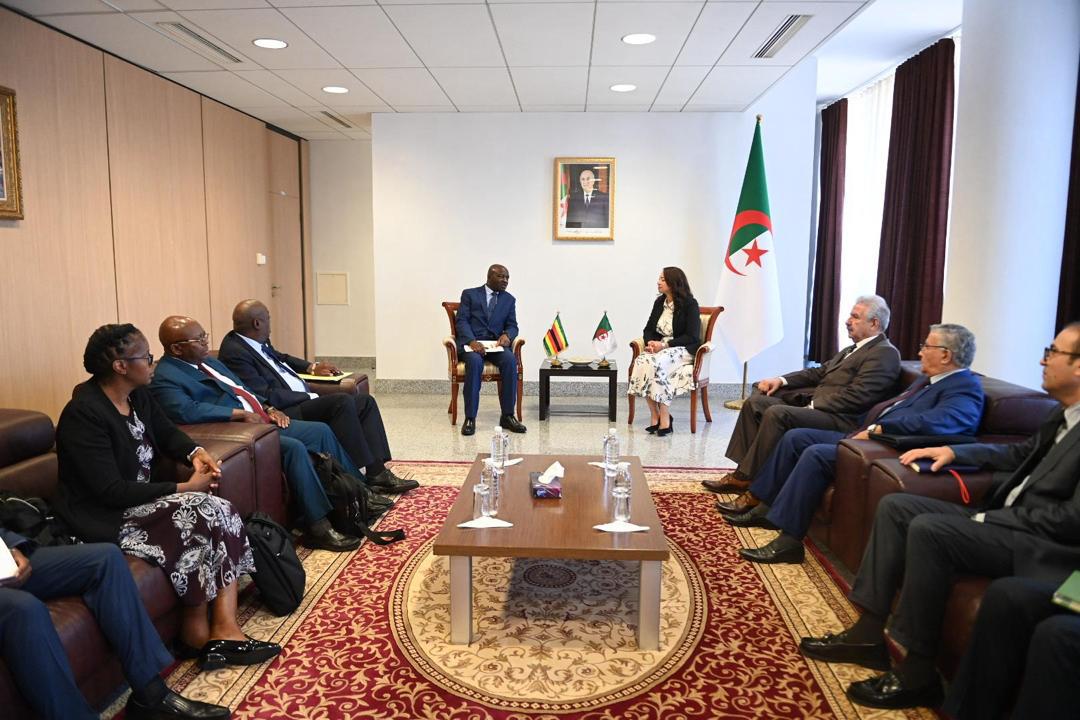
On Wednesday in Algiers, Bakhta Selma Mansouri, the Secretary of State to the Minister of Foreign Affairs, in charge of African Affairs, stated that the creation of a joint business council between Algeria and Zimbabwe would serve as a crucial mechanism to activate cooperation among economic operators and promote investment opportunities.
During her address at the opening of the 4th session of the Algeria-Zimbabwe Joint Cooperation Commission, Mansouri stressed that the establishment of this council “is essential for enhancing collaboration among economic operators, fostering closer ties, and reforming trade exchange mechanisms between the two nations. It also creates an institutional framework for sustainable and mutually beneficial cooperation.” She further noted that Algeria “recognizes the existing potential that could form a solid foundation for an exemplary and evolving partnership, anchored in a shared vision centered on resource utilization and the exchange of expertise.”
In this context, she commended the progress made toward “the signing of several agreements and memorandums of understanding in vital areas such as higher education, vocational training, tourism, and archives.” She affirmed that these agreements, currently under negotiation, reflect “a shared desire to explore new cooperation opportunities in strategic sectors, including agricultural transformation, agri-food industries, manufacturing, startups, micro-enterprises, renewable energy, digitization, transportation, and pharmaceuticals.”
Recalling the historical relationship between Algeria and Zimbabwe, which has been marked by “an honorable history of common struggle for liberation and the defense of national sovereignty, as well as the values of solidarity and respect for Africa worldwide,” Mansouri indicated that “these historical ties have not only facilitated rapprochement but have also provided a strong basis for political understanding, bilateral coordination, and a collective commitment to African solutions for African problems, while rejecting foreign interference and any form of hegemony or dependency.”
“Following the directives of the President of the Republic, Algeria remains dedicated to strengthening and promoting its relations with Zimbabwe, a fraternal nation, within a framework of trust, mutual respect, and national sovereignty,” asserted Mansouri. She believes that this Joint Commission “extends beyond the bilateral framework and embodies a sincere desire to build balanced, effective, and inclusive African cooperation rooted in shared development and continental integration.”
Algeria “places increasing importance on academic training, scientific research, and university exchanges, considering them fundamental to bringing peoples closer together and ensuring the sustainability of long-term partnerships,” she remarked. Mansouri encouraged the presentation of ambitious proposals to foster a culture of learning and research, facilitate knowledge exchange, and initiate joint university programs. She emphasized that both countries should concentrate their collaborative efforts on sectors such as sustainable agriculture, manufacturing, startups, renewable energy, digitization, transportation, and the food and pharmaceutical industries.
Albert Chimbindi, the Permanent Secretary for Foreign Affairs and International Trade of Zimbabwe, remarked that this joint commission acts as “the cornerstone of our relations, providing an organized framework for dialogue and cooperation at bilateral, regional, and international levels.” He emphasized that through this platform, “we aim to deepen and expand areas of cooperation and coordination regarding our priorities and positions.”
Chimbindi expressed his heartfelt appreciation to Algeria for its ongoing support to Zimbabwe, particularly in education, engineering, and health. He noted a significant increase in the number of annual scholarships offered, which has risen from 100 to 250. He underscored the importance of translating the strong political ties between the two nations into tangible outcomes for socio-economic development.
He also commended the broadening cooperation between Zimbabwe and Algeria, which now includes sectors such as agriculture, metallurgy, education, health, energy, tourism, sports, culture, and investment promotion. Chimbindi voiced his eagerness to finalize the memoranda of understanding currently under negotiation, aiming to sign them “during this session or as soon as possible.”
The Zimbabwean official advocated for leveraging the continental free trade agreement to enhance bilateral trade, stating that Zimbabwe “is prepared and eager to position itself as an industrial and logistics hub, even serving as a commercial center for Algerian companies in the Southern Africa region.”