UNSC: Algeria Reiterates Call for Inter-Libyan Dialogue as Sole Solution to Overcome Disputes

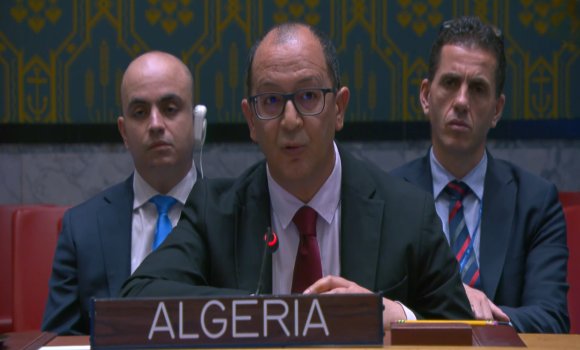
On Thursday, Algeria reiterated its call at the United Nations Security Council for all Libyans to prioritize dialogue as the “only solution to overcome disputes.” The country urged a sense of responsibility and emphasized placing the supreme interests of the Libyan people above all else, particularly in light of the recent armed clashes in Tripoli that resulted in loss of life.
In his address during a Security Council meeting following a briefing by the Prosecutor of the International Criminal Court (ICC), Algeria’s Deputy Permanent Representative to the UN, Toufik Laïd Koudri, implored “all Libyan brothers to engage in dialogue as the sole means of resolving differences,” advocating for a strong sense of responsibility and patriotism while prioritizing the welfare of the Libyan people.
Koudri stressed that Libya, now more than ever, needs to “unite all its children, moving beyond division and discord.” He highlighted the importance of “reviving the political process under the auspices of the United Nations to achieve the long-awaited resolution.”
The Algerian representative underscored the necessity of supporting Libya in breaking free from the cycle of violence through “the immediate and unconditional withdrawal of all foreign forces, fighters, and mercenaries, allowing Libyans to determine their own fate and manage their affairs independently, free from regional tensions and struggles for influence.”
“Libya is not a battleground but an ancestral nation deeply rooted in history, endowed with resources that could enable it—if peace and security are achieved—to play a stabilizing role not only in North Africa but also in the Mediterranean basin and across the entire African continent,” he asserted.
He further emphasized that establishing justice in Libya, as in other nations worldwide, “is a legitimate national demand and an authentic right that should not be subject to controversy or bargaining, nor dictated by external circumstances.” Based on this firmly held belief, Algeria maintains that the ICC’s jurisdiction over the situation in Libya “must operate within the principle of complementarity with the national judiciary, rather than being based on its exclusion or substitution,” he added.
Achieving justice in Libya falls under its sovereign judicial competence, making it vital to concentrate efforts on “enhancing cooperation and coordination between the relevant Libyan jurisdictions and the ICC to ensure thorough investigations into the crimes and violations committed, as well as to guarantee fair and transparent trials for those prosecuted,” Koudri noted.
In this context, Algeria commended the “positive” cooperation of the Libyan authorities with the ICC, as highlighted by the Prosecutor in his latest report. He called for “the expediting of ongoing investigations into the cases submitted to the Court regarding the situation in Libya, aiming for their definitive closure as soon as possible.”
Algeria has underscored the importance of the international community, particularly the United Nations and its mission in Libya, in supporting the Libyan justice sector. This support should involve “intensifying training programs and transferring knowledge and expertise to enable this sector to effectively fulfill its role as the legitimate authority.”
For Algeria, achieving justice and strengthening the judiciary in Libya cannot “emerge from a vacuum or be imposed through external pressures or policies of encouragement or intimidation.” The country emphasized that “this goal can only be realized by creating the necessary objective conditions, foremost among them political and security stability and social well-being,” all of which are currently lacking in Libya. Despite the substantial potential of the country and the economic development opportunities available, ongoing divisions and conflict—exacerbated by acute polarization, foreign interference, and the presence of foreign military forces—continue to obstruct progress toward a political resolution of the crisis.