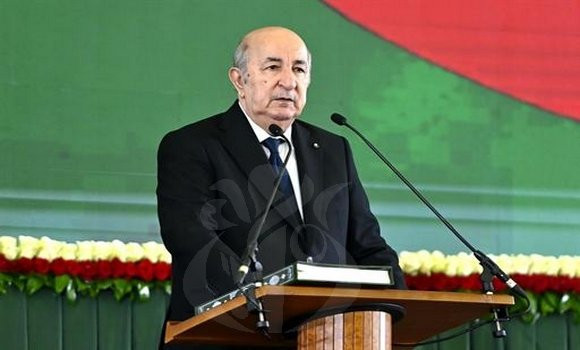
Algerian President Abdelmadjid Tebboune, during his oath-taking ceremony at the Palace of Nations in Algiers, declared his intent to raise the level of economic ambitions in his second term. His primary focus will be on enhancing economic performance, particularly through increasing GDP and encouraging both national and foreign investments. Tebboune aims to position Algeria as an emerging economy, setting a target of achieving a GDP of USD 400 billion. He emphasized his commitment to his electoral promises, with a focus on sustained growth and attracting significant investments.
The President acknowledged Algeria’s current economic growth, one of the highest in the Mediterranean region, and the goal to maintain a steady growth rate of 4% in the coming years. Tebboune outlined a clear strategy to diversify Algeria’s economy, aiming to reduce its dependency on hydrocarbons. A significant target is to boost non-hydrocarbon exports to USD 15 billion during his second term. He emphasized that Algeria’s investment climate has improved, citing nearly 9,000 registered investment projects that will create wealth and jobs, with a goal to reach 20,000 projects.
In addition to large-scale investments, Tebboune highlighted Algeria’s growing start-up ecosystem, with the number of companies increasing from 200 to nearly 8,000 during his first term. The President aims to expand this number to 20,000 by the end of his second term. He also discussed the revitalization of the industrial sector, which had declined from 19% to 3.5% of GDP since the 1970s but grew to 5% during his first term. He pledged to increase this contribution to 12% by the end of his second term, underscoring the significance of the industrial and mining sectors in the national economy.
The President also noted substantial progress in agriculture, especially in strategic crops like wheat, barley, and corn. Algeria is set to achieve self-sufficiency in durum wheat by 2025 and in barley and corn by 2026. The expansion of irrigated areas, along with the construction of five desalination plants by the end of the year, reflects his administration’s focus on improving water resources. Large-scale water projects, including the interconnection of dams, are expected to ensure long-term water availability.
Lastly, Tebboune reaffirmed his commitment to social issues, including safeguarding purchasing power, creating 450,000 jobs, and building two million housing units. He also promised to raise rural housing assistance and combat inflation. Additionally, the President expressed his determination to resolve the challenges in underdeveloped areas during the first year of his second term, reiterating his dedication to national progress and economic transformation.