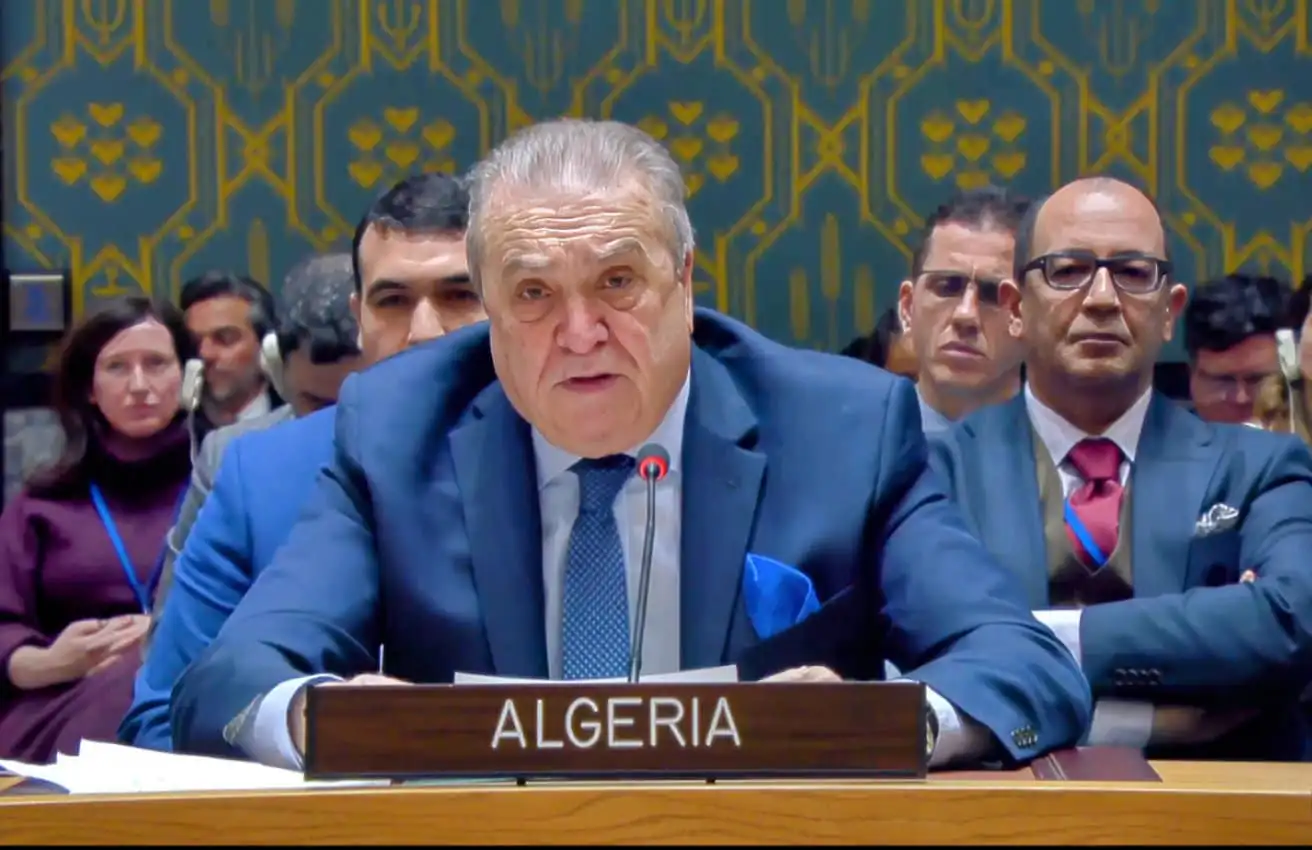
The Permanent Representative of Algeria to the United Nations, Mr. Amar Bendjama, asserted on Friday that the only way to end the ongoing tragedy in Gaza – undergoing genocidal Zionist aggression for nearly ten months—is by guaranteeing the Palestinian people’s inalienable right to establish an independent state with AL-QUDS AL-SHARIF as its capital.
“The solution to this dreadful tragedy is clear as a bell, as President Abdelmadjid Tebboune audaciously stated: ‘We must ensure the inalienable right of the Palestinian people to their own independent state, with Al-Quds Asharif as its legitimate capital.” Mr. Bendjama stated during a Security Council meeting on “the situation in the Middle East, including the Palestinian issue,” convened by Algeria, China, and Russia.
He emphasized that this issue represents a “moral imperative and a historical debt that humanity must urgently settle.”
Mr. Bendjama highlighted that the session aimed to “underscore the urgent necessity of uniting our efforts and coordinating our response to the humanitarian crisis in Gaza.”
“Our meeting today symbolizes a beacon of hope—hope that we can set aside our differences and unite in our shared humanity. However, hope alone is insufficient; the people of Gaza need more than our sympathy,” he underscored.
Painting a grim picture of the prevailing situation in Gaza, where children cry from hunger and hospitals are overwhelmed, Mr. Bendjama called for action against a catastrophe that “challenges the very essence of our humanity.”
“Today, 96% of Palestinian children and women face food insecurity in Gaza. Images of Palestinian children standing in line for food or eating tree leaves should challenge our humanity and spur us into action,” he insisted, noting that “history will judge us.”
The Permanent Representative of Algeria to the United Nations also condemned “the deliberate Zionist policies obstructing access to and distribution of food aid.”
To support his statements, he referenced data from the UN Office for the Coordination of Humanitarian Affairs (OCHA), which indicated that during the first two weeks of July, only 86 trucks entered Gaza daily, significantly fewer than the 500 trucks that previously entered the Palestinian enclave each day.
“Due to a lack of order and security, humanitarian actors struggle immensely to deliver aid to Gaza’s civilian population,” he denounced, emphasizing that the responsibility lies entirely with the occupying power, which even targets peacekeepers and the UN Relief and Works Agency for Palestine Refugees (UNRWA).
“Targeting UNRWA or handcuffing its employees—the only humanitarian agency still capable of delivering aid—is another facet of the policy pursued by the Zionist entity,” he added.
Citing an alarming report published by the World Health Organization (WHO) on July 16, which detected poliovirus in Gaza’s wastewater, Mr. Bendjama warned of another silent threat that could soon materialize.
“The healthcare system has been destroyed, and amid the rubble of hospitals and clinics, a new epidemic looms on the horizon. This is not just a crisis; it is a full-blown catastrophe,” he stated.
To address the dire humanitarian situation in Gaza, Mr. Bendjama explained that Algeria calls for several measures to be taken.
This includes “opening all border crossing points, including the Rafah crossing, which should be managed exclusively by Egypt and the Palestinian Authority. Additionally, implementing Resolution 2720 by deploying observers to Rafah is essential to ensure the unimpeded access of humanitarian aid.”
It also involves “allowing UNRWA and other humanitarian organizations to distribute aid throughout the Gaza Strip, launching a large-scale vaccination campaign led by the WHO to prevent the spread of polio among children, and ensuring a ceasefire to facilitate meaningful humanitarian actions.”
Reacting to the advisory opinion of the International Court of Justice (ICJ), Mr. Bendjama emphasized that it represented “a glimmer of hope and a step towards a sustainable solution to the ongoing crisis in the Middle East.”
“Those who believe in the international order should strive to implement this opinion, which is not merely a legal document but rather a moral compass that we must follow to create a world where international law protects the most vulnerable and holds the powerful accountable for their actions,” he noted.